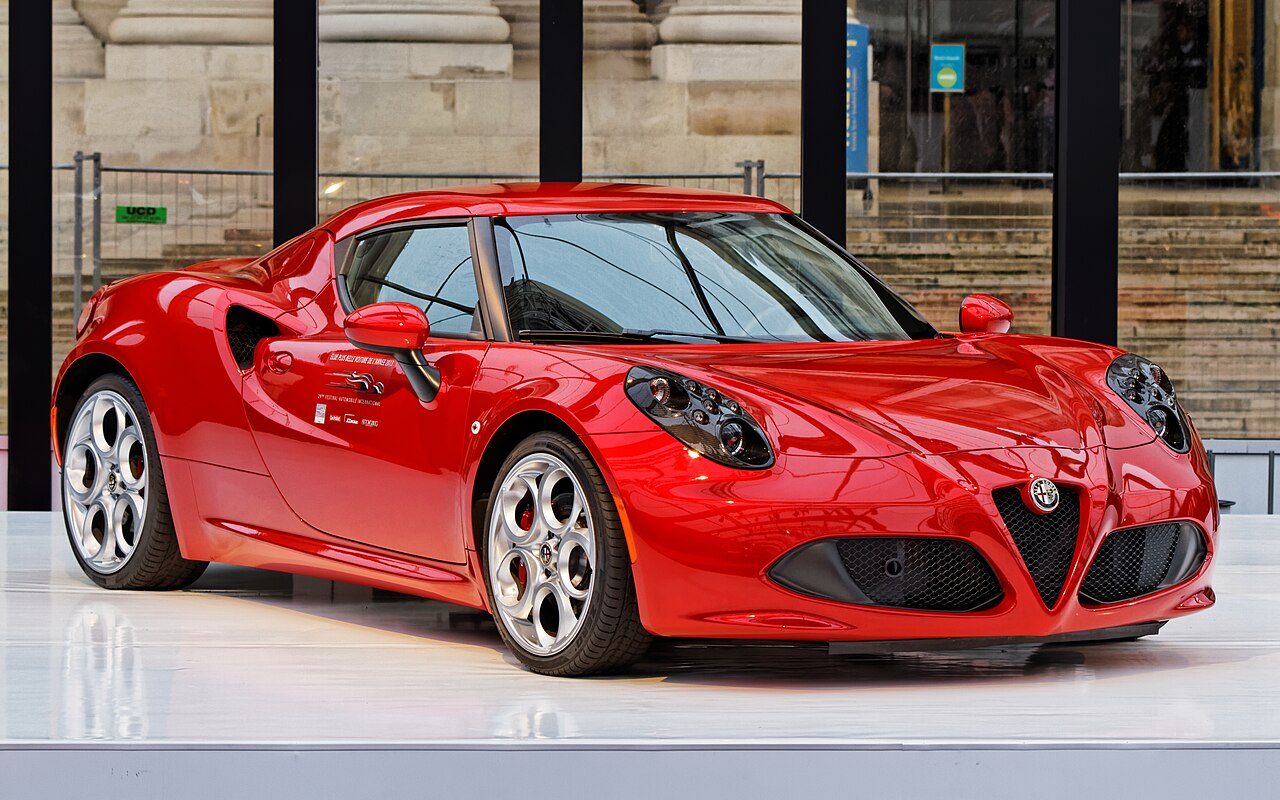
The Alfa Romeo 4C arrived in 2013 as a lightweight, mid-engine sports car built around a carbon-fibre monocoque — a genuine halo machine that announced Alfa Romeo's return to focused, driver-led performance. With a turbocharged four-cylinder, rear-wheel drive and a kerb weight of under 1,000 kg, it was a purist's sports car in a digital age.
Generations and evolution
4C coupe (2013–2020)
The original fixed-roof 4C, with a carbon tub, 1.75-litre turbo four and a steering setup tuned for feel over assistance.
4C Spider (2015–2020)
An open-top version that kept the carbon structure while adding open-air drama.
Design language and the silhouette
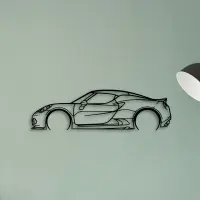
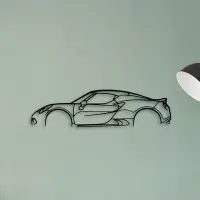
Low, wide and unmistakably Italian: a short nose, sculpted side air intakes and a cabin pushed toward the rear axle, all shaped around the carbon tub that gives the car its structure. Because we cut every Tinvibe piece from 2 mm steel to the car's true outline, the traits that make the Alfa Romeo 4C recognizable — its roofline, stance and key details — are exactly what the metal keeps, in matte black powder coat across five sizes from 50 cm to 140 cm.
Production, sales and availability
Alfa Romeo has not published a single lifetime 4C total, so we avoid quoting one; production ended around 2020, and the 4C is already valued as a modern classic lightweight.
The 4C in the Tinvibe collection
We cut the Alfa Romeo 4C as a laser-cut steel silhouette in five sizes from 50 cm to 140 cm, finished in matte black powder coat. The designs below are drawn from our catalogue for this nameplate.