
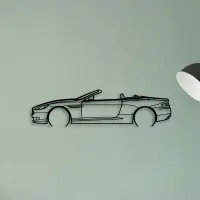
The Aston Martin DB9 Convertible is a open-top shape in the Tinvibe catalogue, and it is the outline rather than the badge that carries it. A low roofline that disappears when the top is down is what reads first when the piece is cut from 2 mm steel.

What the silhouette actually shows
Strip away paint, trim and wheels and a car becomes one continuous line. For the Aston Martin DB9 Convertible that line is a low roofline that disappears when the top is down, and those are the features our cut follows. This is why a silhouette can be recognised at a distance where a photograph cannot: the eye reads proportion before detail.
Proportion cues to look for
- The relationship between roof height and overall length — the Aston Martin DB9 Convertible sits low and long for its class.
- Wheel arch shape and how much of the wheel it exposes.
- Where the shoulder line falls relative to the door handles.
- How quickly the roof drops away behind the cabin.
Production and figures: what we will and will not claim
Tinvibe is a design studio, not an archive. We do not publish production totals, sales figures or launch dates for the Aston Martin DB9 Convertible, and we would rather say so than guess. If you need verified numbers, the manufacturer's own heritage pages are the place to check.
The Aston Martin DB9 Convertible in the Tinvibe range
Every piece is laser cut from 2 mm steel, hand polished and painted, then finished for indoor or sheltered outdoor display. Catalogue pieces for this nameplate cover 2008. Most sit in the 2000s bracket. The outline is taken from the car's true side profile rather than a stylised drawing.
Sizes and prices
- XS — 50 cm, $69.95
- S — 80 cm, $99.95
- M — 100 cm, $119.95
- L — 120 cm, $159.95
- XL — 140 cm, $209.95
How to choose a size
Measure the wall first, not the car. A open-top outline needs roughly 10–15 cm of clear wall on every side to read as a shape rather than a panel. As a working rule: up to 80 cm suits a hallway, desk or shelf wall; 100 cm is the safe default for a living room or office; 120–140 cm is the size that holds a garage or a double-height wall. If you are torn between two, take the larger — an outline that is slightly too big still reads, one that is too small disappears into the wall.
Pairing it with other pieces
A single Aston Martin DB9 Convertible reads as a portrait; two or three read as a collection. The combinations that work are usually contrasts rather than repeats: a open-top shape against a different body style, or the same silhouette in two sizes on one wall. Keep the gap between pieces at 8–12 cm and align them on a common centre line rather than their tops, so the eye reads one group instead of separate objects.
- Match the finish across pieces — one matte piece among gloss ones looks like a mistake.
- Vary the size, not the subject, if you want a calm wall.
- Vary the subject, not the size, if you want a wall that reads as a collection.
- Leave one wall empty; a full room of silhouettes stops reading as deliberate.
Aston Martin DB9 Convertible pieces worth a look
Where to hang it
A open-top outline works best at eye level on a wall you approach from an angle — above a bench, behind a car, or on the back wall of a garage. Give it an even wash of light and the edge stays crisp; a single hard spotlight will throw a shadow that fights the outline.
Care
Dust with a dry cloth. For fingerprints or kitchen film, a damp cloth with a drop of mild detergent is enough — no abrasives, no solvent. The powder coat is weather resistant, but fixings should be checked annually if the piece lives outdoors.