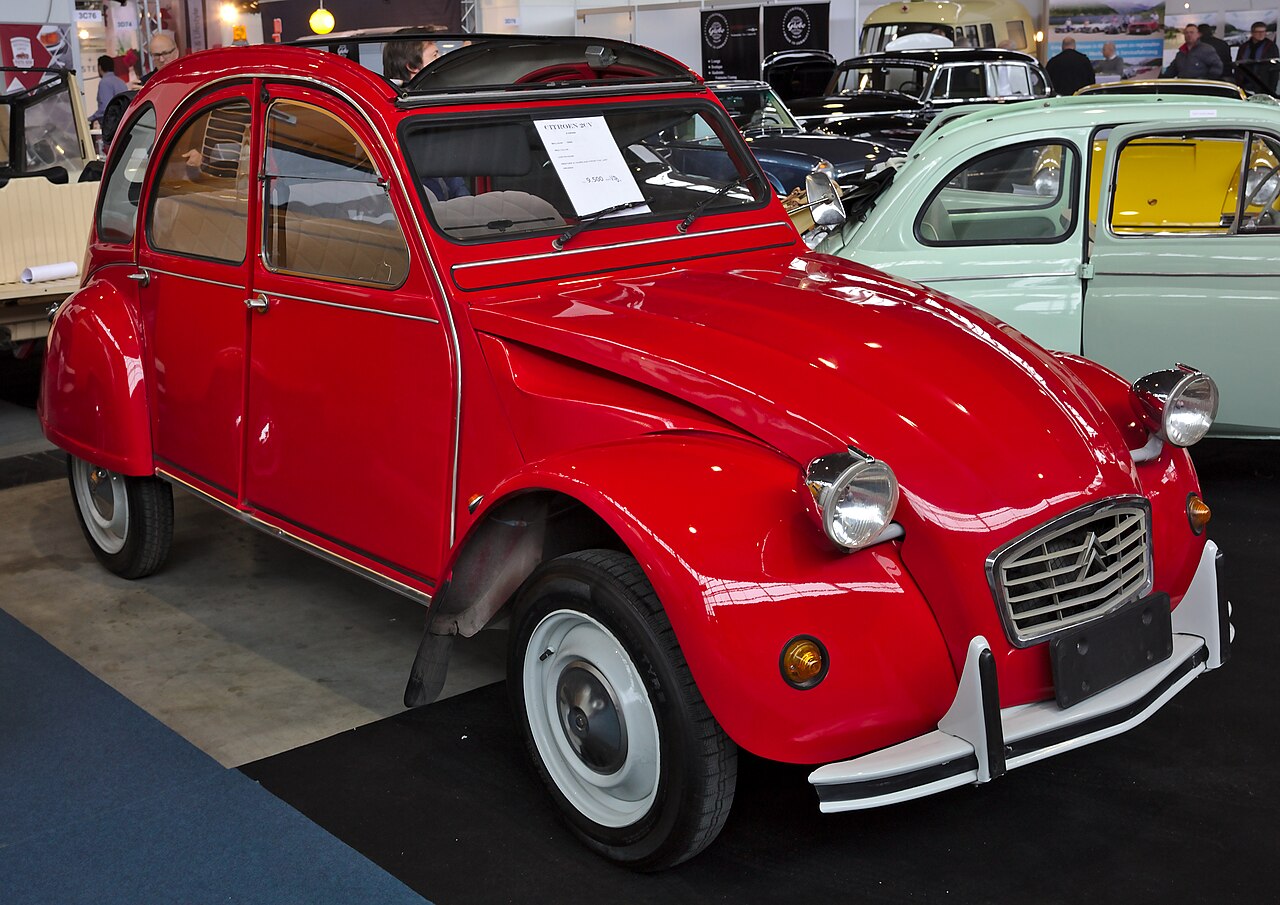
The Citroën 2CV — the 'Deux Chevaux' — was conceived in the 1930s with a famously simple brief: a car that could carry a farmer, a sack of potatoes and a basket of eggs across a ploughed field. Launched in 1948, its air-cooled flat-twin engine, soft suspension and stripped-out simplicity made it the car that literally put France on wheels, and it stayed in production for over forty years.
Generations and evolution
Type A and early 2CV (1948–1960)
The austere originals with the distinctive corrugated metal roof designed to add strength.
Later 2CV (1960–1990)
A long run of refinements, from the 2CV4 to the 2CV6 and special editions, culminating in the last cars built in 1990.
Design language and the silhouette
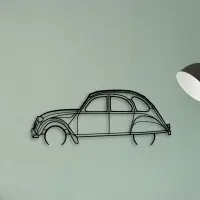
Utterly distinctive and utterly functional: a rounded, almost insect-like body, a ribbed roll-back roof, prominent cycle-style wings and a face that seems to smile. Few cars are so immediately, charmingly recognisable. Because we cut every Tinvibe piece from 2 mm steel to the car's true outline, the traits that make the Citroën 2CV recognizable — its roofline, stance and key details — are exactly what the metal keeps, in matte black powder coat across five sizes from 50 cm to 140 cm.
Production, sales and availability
Citroën built more than five million 2CVs across its long life, making it one of the defining 'people's cars' of the 20th century.
The 2CV in the Tinvibe collection
We cut the Citroën 2CV as a laser-cut steel silhouette in five sizes from 50 cm to 140 cm, finished in matte black powder coat. The designs below are drawn from our catalogue for this nameplate.