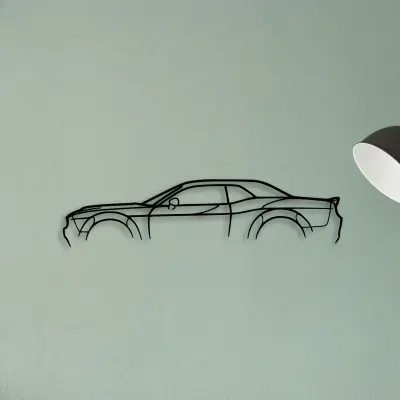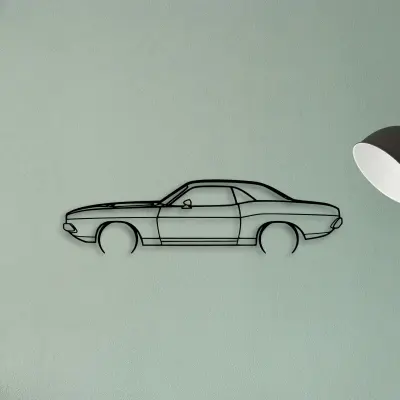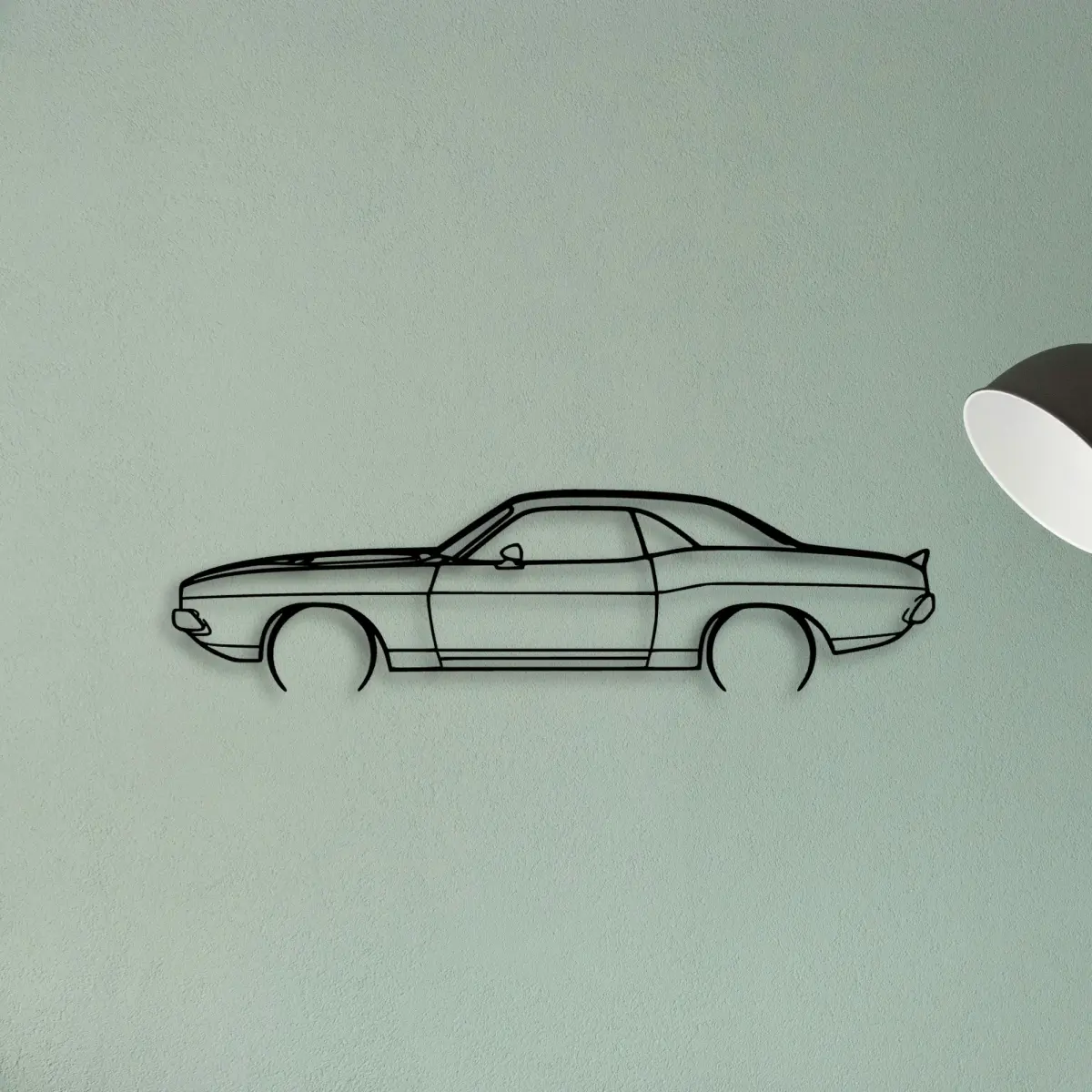
The Dodge Challenger launched in 1970, a year after the Camaro and Mustang had matured, as a longer, wider pony car. After a single original generation it vanished, then returned in 2008 as a retro-inspired V8 coupe that carried the modern muscle-car torch.
Generations and evolution
First generation (1970–1974)
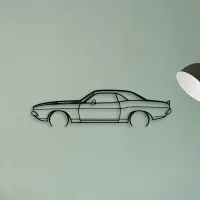
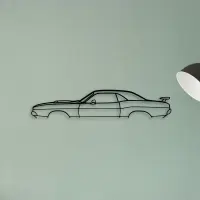
The iconic original: a broad, Coke-bottle coupe with the 426 Hemi and 440 Six Pack, plus the racing-style Challenger T/A.
Second generation / modern (2008–2023)
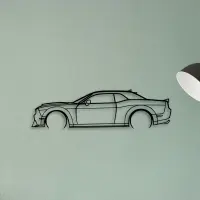
A retro, rear-wheel-drive LX coupe that grew into the Hellcat (2015), the Demon (2018), and the Super Stock before the 'Last Call' editions ended it in 2023.
Design language and the silhouette
The original is all width and stance: a wide grille, a long hood, and a fastback roof. The modern car is a faithful retro echo, and the Hellcat's hood scoop and widebody fenders make the most aggressive version of the shape. Because we cut every Tinvibe piece from 2 mm steel to the car's true outline, the traits that make the Dodge Challenger recognizable — its roofline, stance and key details — are exactly what the metal keeps, in matte black powder coat across five sizes from 50 cm to 140 cm.
Production, sales and availability
Dodge built around 165,000 Challengers for 1970 and similar numbers through 1974; the modern car sold in the hundreds of thousands. The Demon was limited to about 3,300 units.
The Challenger in the Tinvibe collection
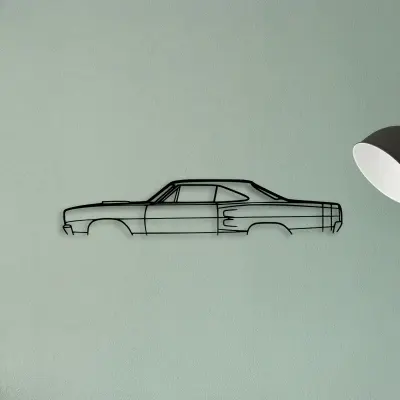
We cut the Dodge Challenger as a laser-cut steel silhouette in five sizes from 50 cm to 140 cm, finished in matte black powder coat. The designs below are drawn from our catalogue for this nameplate.