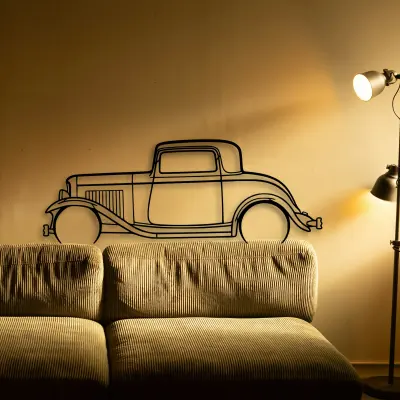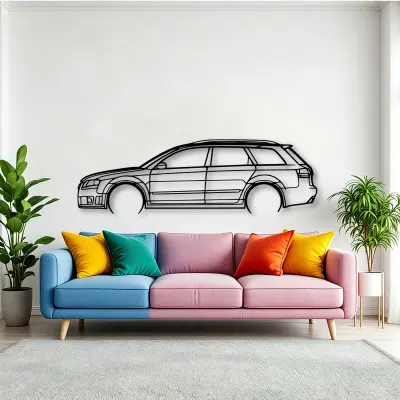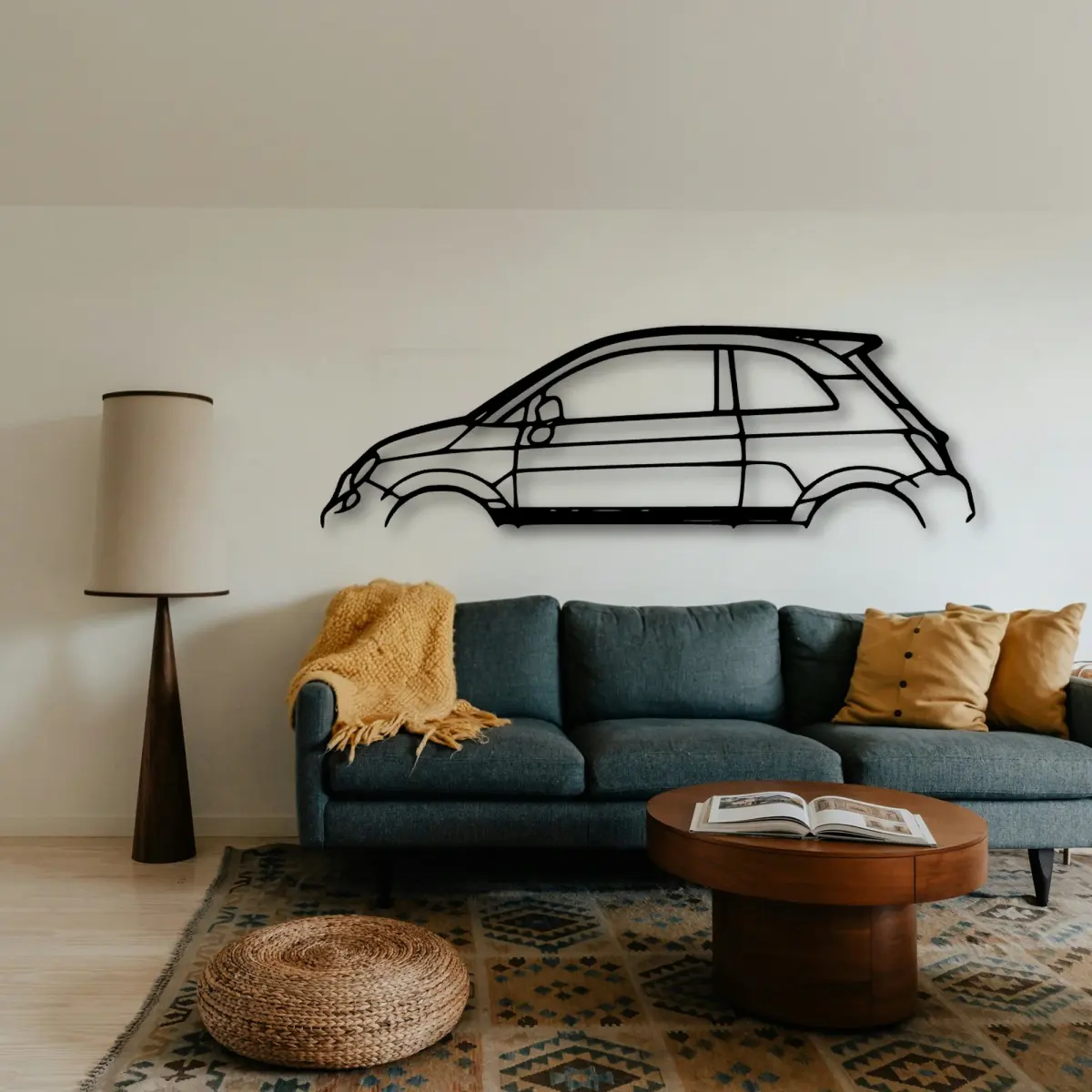
A cut outline strips a Fiat 500 Abarth back to the one thing that makes it recognisable: its outline. That outline is what matters, and it is worth understanding before you choose a piece for the wall.
The Fiat 500 Abarth pieces in our range are formed from sheet metal and delivered ready to fix to the wall, with the price stepping from $69.95 at 50 cm to $209.95 at 140 cm, a range that lets the same outline work above a worktop or across a full wall.
What the Fiat 500 abarth keeps
Strip a Fiat 500 Abarth back to a stance and almost everything disappears except the line. The Fiat 500 Abarth is what survives, and it is usually the single most identifying feature of the car.
That is the discipline of cut-metal art: you cannot hide a weak proportion behind a colour or a reflection. The Fiat 500 Abarth either comes across as itself or it does not.
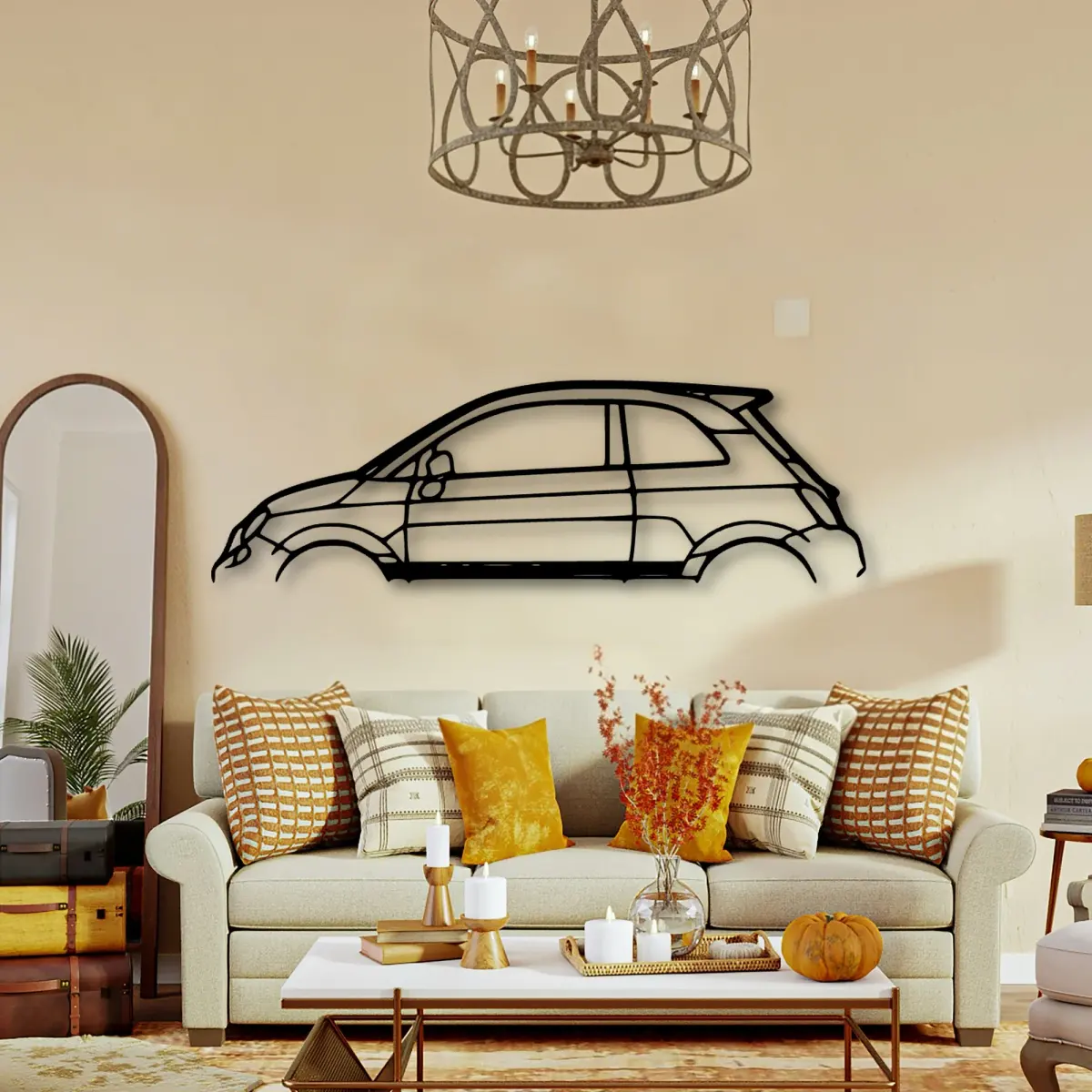
Grouping more than one
If you collect, let the Fiat 500 Abarth be one of a set with a rule. The Fiat 500 Abarth next to its rivals makes the differences obvious in a way no spec list ever does.
Build the set
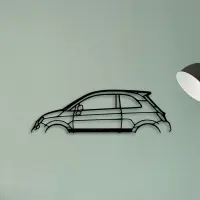
Pairs that work on one wall
If you group pieces, let the Fiat 500 Abarth sit next to something with a contrasting roofline. The Fiat 500 Abarth against a opposite proportion is far more interesting than two shapes that rhyme.
Start a paired wall
Make, written in the outline
You can often guess the make of a Fiat 500 Abarth from the line alone. The Fiat 500 Abarth is a small lesson in how a brand draws, reduced to a single edge.
Wheel arch and sill
A shape lives in the lower edge as much as the roof. The Fiat 500 Abarth needs its arches cut clean or the whole shape looks unsupported.
- Tight arches: taut and purposeful.
- Open arches: relaxed and mechanical.
- A clean sill: the line the eye rests on.
Why this outline holds up
As a Fiat shape, the Fiat 500 Abarth carries a brand outline you recognise before you read a badge, which is why the shape works as wall decor.
The roofline and the glasshouse
The glasshouse, the area of glass above the beltline, decides whether a Fiat 500 Abarth looks airy or blunt. A low, long roof works as fast; a tall one works as practical, and the cut keeps exactly that cue.
Watch the greenhouse on the Fiat 500 Abarth: where it starts, how far it reaches, and how it meets the rear. Those are the lines a shape has to protect or the car loses its character.
Why the cut-out reads like air
What is removed matters as much as what stays. The negative space inside a Fiat 500 Abarth shape is where the wall shows through, and that emptiness is what makes the car shape pop.
The cut is not a drawing of a car. It is the car's outline, and the wall does the rest.
Monochrome as a feature
If you want art that never clashes, a single-material Fiat 500 Abarth is the answer. The Fiat 500 Abarth in cut steel is the same colour as the wall's shadow, so it always belongs.
How it comes across as a shape
Take the panels away and the Fiat 500 Abarth is just a few strong lines. Get those lines right and the Fiat 500 Abarth reads correctly from from across the space.
- The beltline: where glass meets body, the strongest horizontal in the profile.
- The roofline: its curve or flatness sets the whole mood of the piece.
- The wheelbase: long or short, it is what makes the car look planted or lively.
Cut versus photograph
The Fiat 500 Abarth as a shape is an argument about essentials. Where a photograph shows you the car was there, the Fiat 500 Abarth cut shows you what the car is.