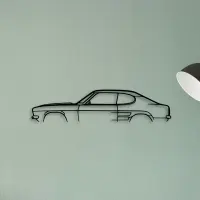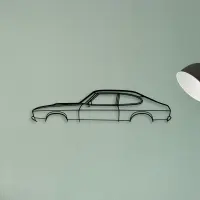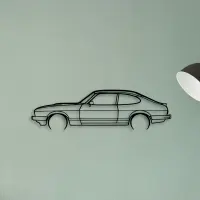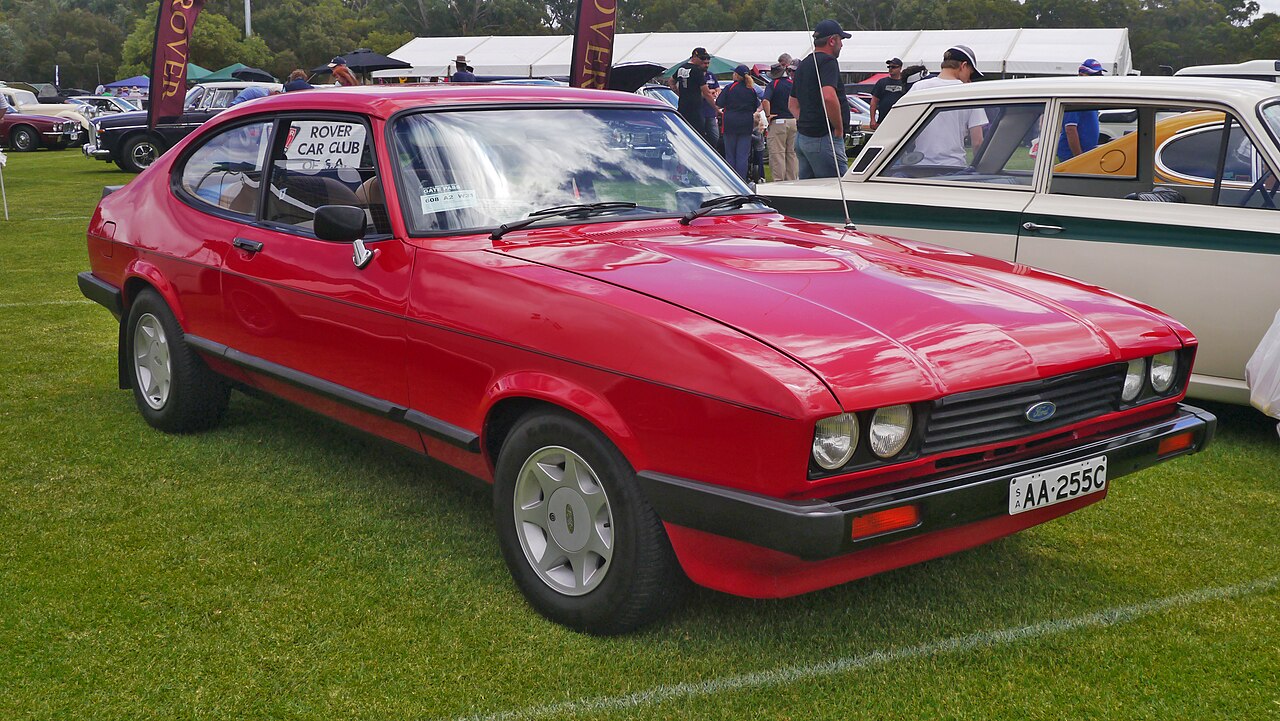
The Ford Capri launched in 1969 as a European sports coupe with long-hood, short-deck styling inspired by the Ford Mustang. Built in Cologne for the European market, it offered a range of engines from modest fours to strong V6s and became one of Ford of Europe's most successful sports cars, staying in production until 1986.
Generations and evolution
MkI (1969–1974)
The original Capri, widely regarded as the best-proportioned, with a clean fastback shape and a range of Kent and Cologne engines.
MkII (1974–1978)
A revised version with updated styling and the introduction of hatchback models and stronger Ghia and RS trims.
MkIII (1978–1986)
The final, more angular generation, including the turbocharged Capri Turbo and the last of the line.
Design language and the silhouette
A classic long-hood, fastback coupe profile — the MkI in particular is a clean, low 1970s sports-coupe shape that echoes its Mustang inspiration. Because we cut every Tinvibe piece from 2 mm steel to the car's true outline, the traits that make the Ford Capri recognizable — its roofline, stance and key details — are exactly what the metal keeps, in matte black powder coat across five sizes from 50 cm to 140 cm.
Production, sales and availability
Ford has not published a single combined Capri total across its generations, so we avoid quoting one; the MkI is the most collectible.
The Capri in the Tinvibe collection
We cut the Ford Capri as a laser-cut steel silhouette in five sizes from 50 cm to 140 cm, finished in matte black powder coat. The designs below are drawn from our catalogue for this nameplate.