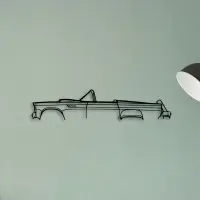
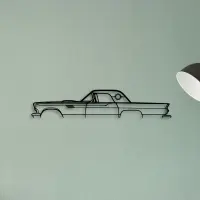
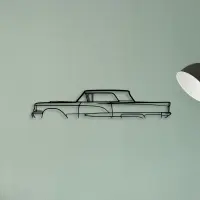
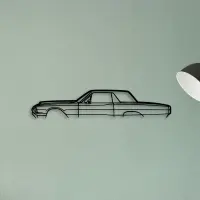
The Ford Thunderbird launched in 1955 as Ford's answer to the Chevrolet Corvette and the European sports cars — a low, two-seat convertible built for comfortable cruising rather than outright speed. It was a hit, and when Ford added a rear seat for 1958 it effectively created the 'personal luxury car' class, a formula it refined across eleven generations through to 1997.
Generations and evolution
First generation (1955–1957)
The original two-seat 'Square Bird', widely considered one of the most beautiful American cars of the 1950s.
Second to fourth generations (1958–1971)
The Thunderbird grew into a larger four-seat luxury coupe, competing with the Lincoln Mark series.
Fifth to tenth generations (1972–1997)
A long evolution from big, boat-like coupes to the 1980s turbocharged 'TBird Super Coupe' and the retro-styled eleventh generation of 2002.
Design language and the silhouette
The first-generation two-seater — with its wrap-around windshield, hood scoop and sleek flanks — is the definitive Thunderbird silhouette, and the one that still defines personal-luxury style. Because we cut every Tinvibe piece from 2 mm steel to the car's true outline, the traits that make the Ford Thunderbird recognizable — its roofline, stance and key details — are exactly what the metal keeps, in matte black powder coat across five sizes from 50 cm to 140 cm.
Production, sales and availability
Ford built the Thunderbird across multiple long production runs, with the two-seat first generation the rarest and most collectible; total lifetime production spanned several hundred thousand cars across the generations.
The Thunderbird in the Tinvibe collection
We cut the Ford Thunderbird as a laser-cut steel silhouette in five sizes from 50 cm to 140 cm, finished in matte black powder coat. The designs below are drawn from our catalogue for this nameplate.