The Pontiac Trans Am arrived in 1969 as the performance trim of the Firebird, Pontiac's answer to the Ford Mustang. Named for the Trans-Am racing series, it combined big V8 power with wild graphics — including the famous 'screaming chicken' firebird hood decal — and became one of the most recognisable American muscle cars, immortalised on screen in Smokey and the Bandit and Knight Rider.
Generations and evolution
First generation (1969)
A limited run of roughly 700 cars with ram-air V8 power, setting the template for the nameplate.
Second generation (1970–1981)
The blocky, aggressive F-body that defined the muscle era; the 1977 Special Edition with its black-and-gold scheme became the Bandit's car.
Third generation (1982–1992)
A sleeker, more aerodynamic shape. The 1982 model became KITT in Knight Rider, and the WS6 and GTA brought the Trans Am back toward true performance.
Design language and the silhouette
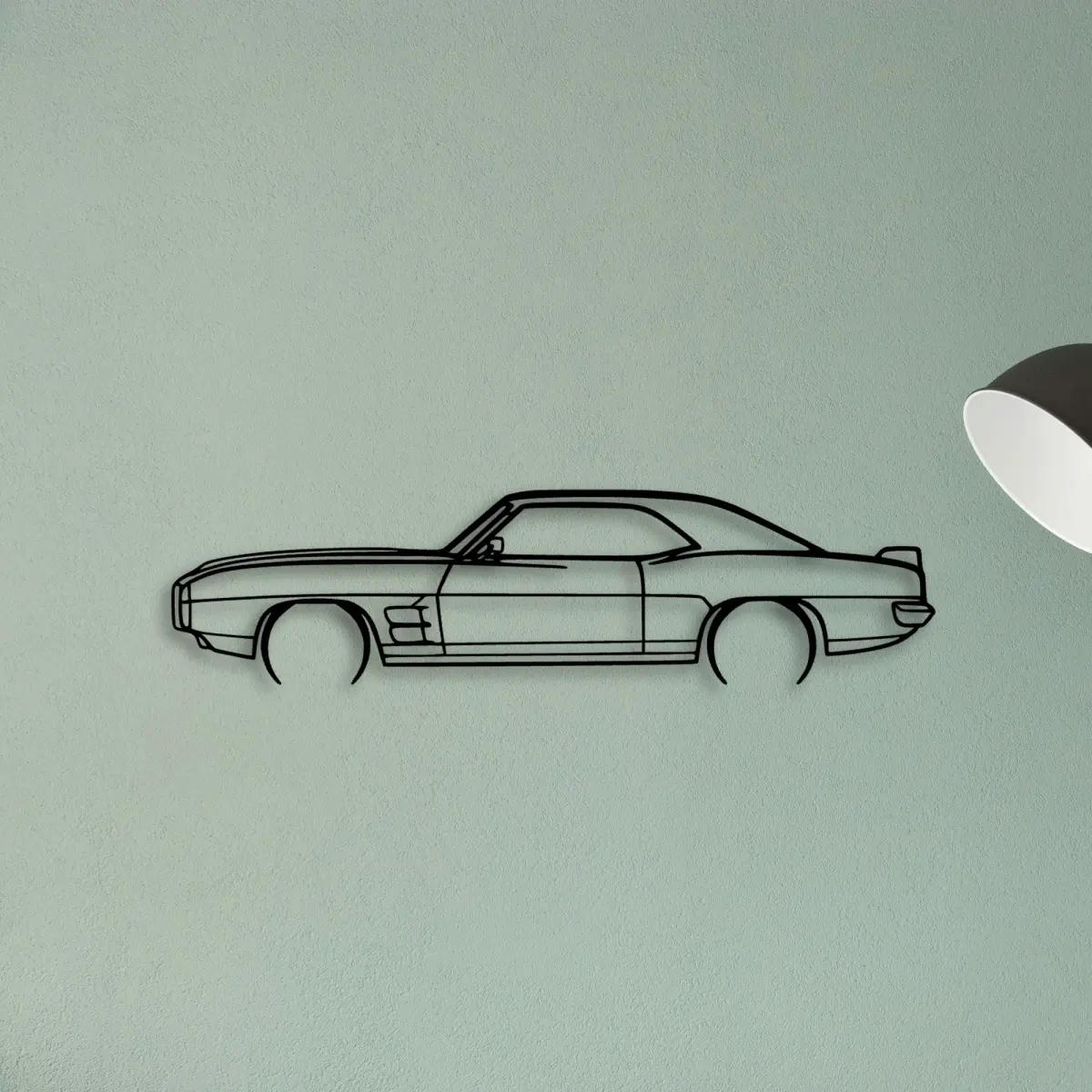
Wide arches, a low nose and, above all, that giant hood decal — the Trans Am's look is pure 1970s American confidence, with the firebird graphic spreading across the bonnet. Because we cut every Tinvibe piece from 2 mm steel to the car's true outline, the traits that make the Pontiac Trans AM recognizable — its roofline, stance and key details — are exactly what the metal keeps, in matte black powder coat across five sizes from 50 cm to 140 cm.
Production, sales and availability
Pontiac has not published a single combined Trans Am total across its generations, so we avoid quoting one. Production ended with the Firebird in 2002, and clean second- and third-generation cars are now firmly collector material.
The Trans AM in the Tinvibe collection
We cut the Pontiac Trans AM as a laser-cut steel silhouette in five sizes from 50 cm to 140 cm, finished in matte black powder coat. The designs below are drawn from our catalogue for this nameplate.