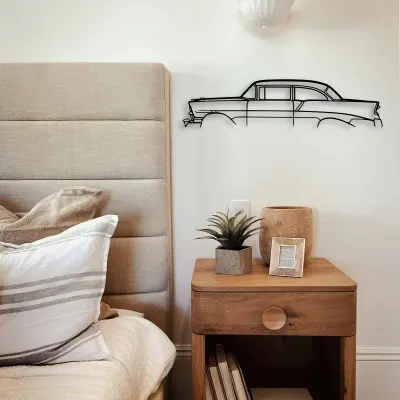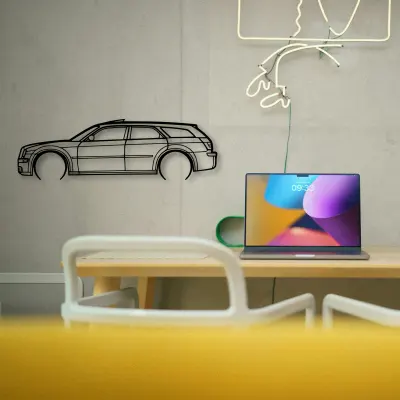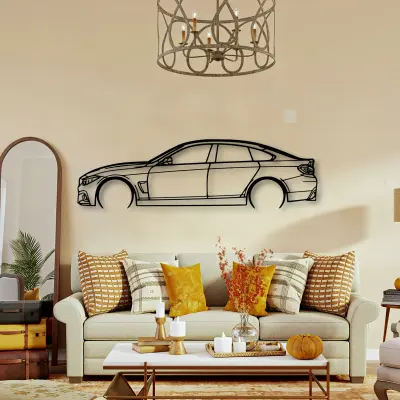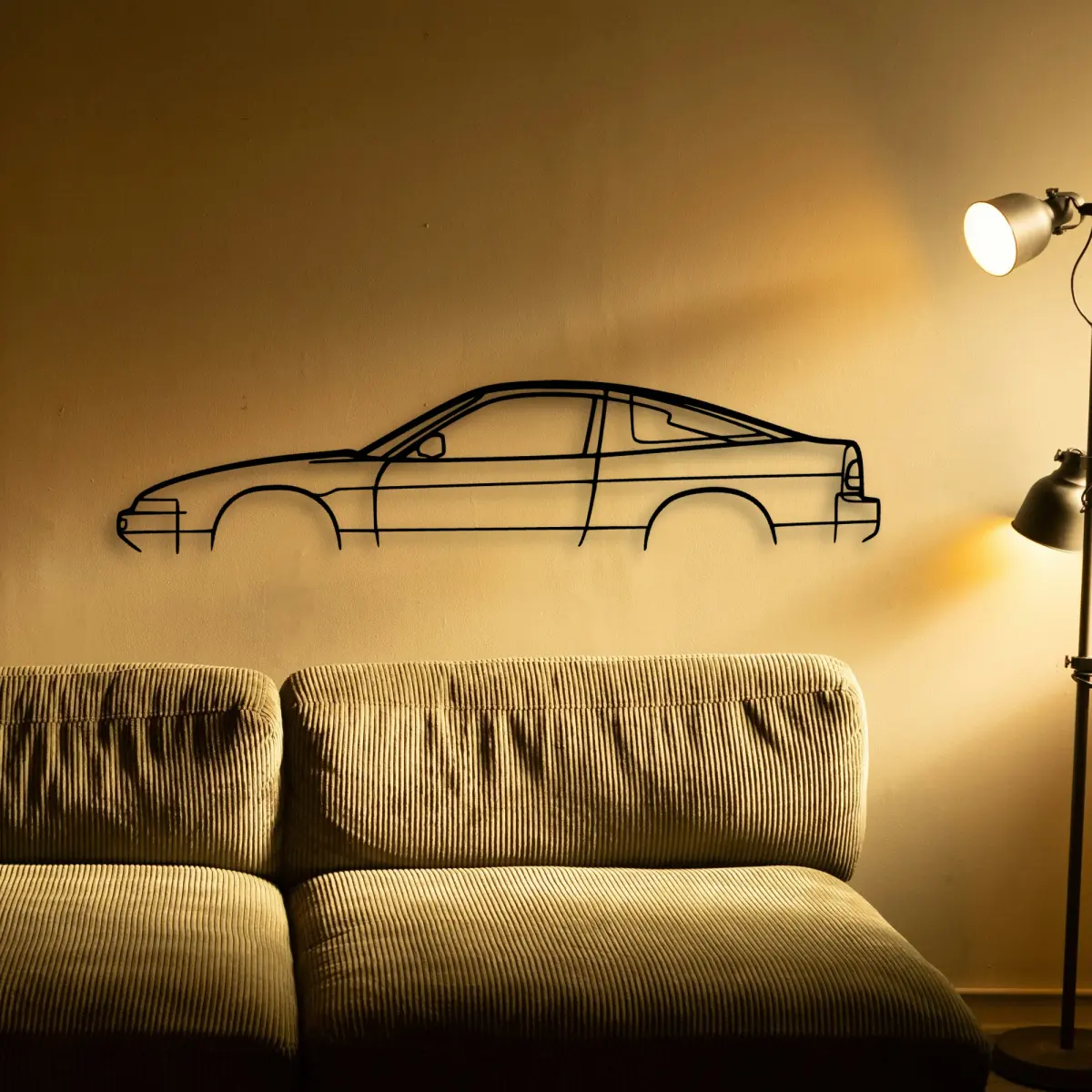
Most photos of metal art fail for one reason: they fight the piece. A Nissan profile wants clean light and a calm background, not a clever setup.
What makes the Nissan work as metal art is that it carries no colour of its own. Cut from sheet metal and finished for display indoors, it sits quietly in almost any room while the outline does the talking.
Reading it from across the room
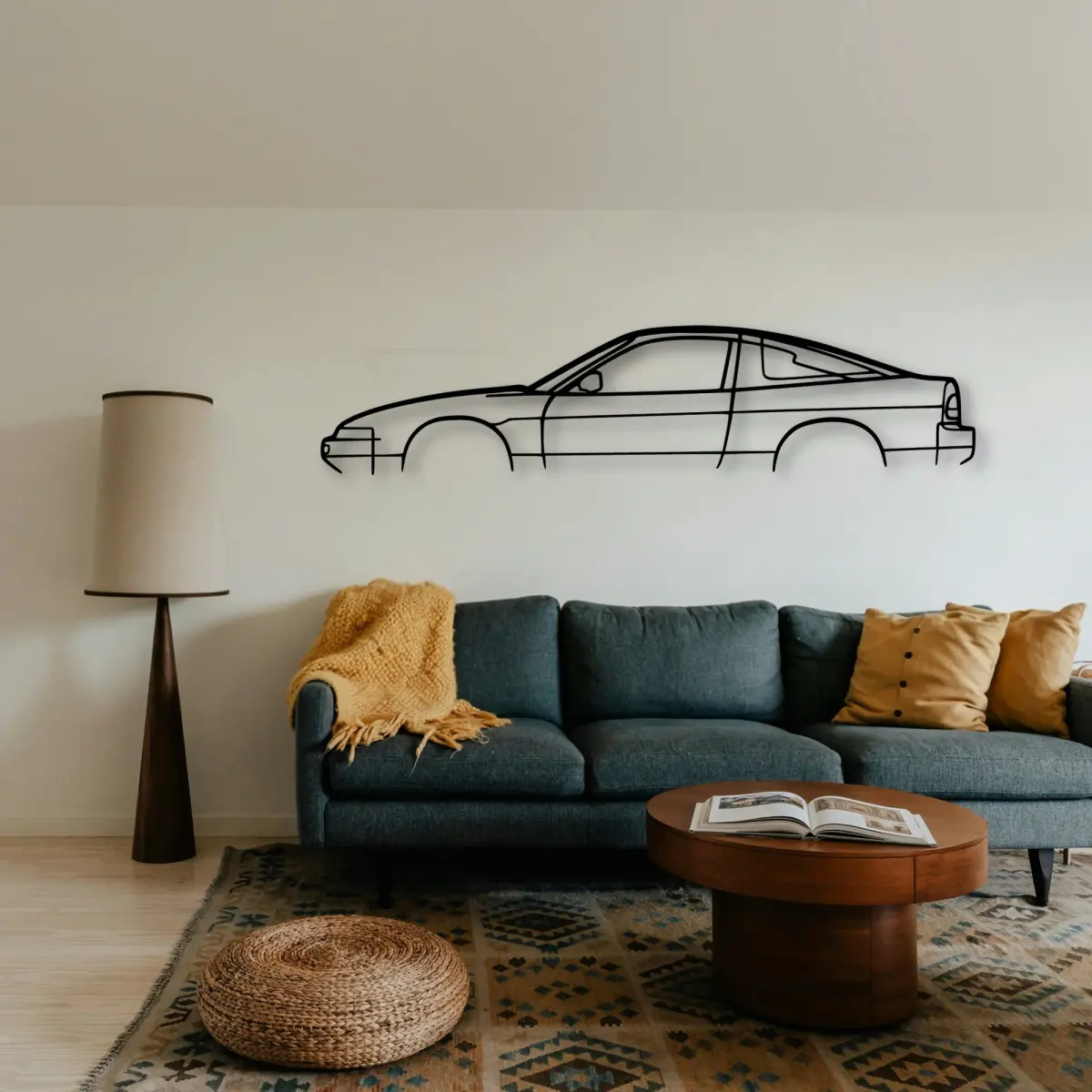
A Nissan profile has to work at distance, not just up close. At 120 cm it keeps its identifying line legible from the other end of the room.
Size ladder, one outline
Every Nissan profile comes in the same size ladder: 50 cm, 80 cm, 100 cm, 120 cm and 140 cm. The price steps with the size, from $69.95 to $209.95.
- 50 cm — a shelf or a study; an accent, not a feature.
- 80 cm — still modest, but reads across a doorway.
- 100 cm — the safe feature-wall default.
- 120 cm — for rooms where the car is the subject.
- 140 cm — the full statement piece.
Overcast is underrated
On grey days the light is even and soft, which flatters a Nissan profile without hotspots. Overcast is the easiest shoot you will get.
Honest material, no colour
A Nissan profile in steel asks the line to do all the work — there is no livery, no badge colour, no gradient to lean on.
More than one on the backing
If you collect, let the Nissan be one of a set with a rule. Next to its rivals, the differences are obvious.
Build the set
A single strong subject is easier to live with than a wall that argues with itself.
Scale matters more than people expect. A piece that is too small disappears; one that is sized to the backing reads as intentional from the doorway.
The shadow line is the second drawing. Where it falls tells you as much as the metal itself.
Quiet rooms suit a smaller profile; loud rooms need one that can hold its own from across the space.
Metal art works best when it earns its place rather than filling a gap. A single well-chosen outline does more than a row of hesitant decoration.
Cut metal has a weight that printed art lacks. The shadow it casts is part of the piece, not an accident of the light.
A profile on the backing is a quiet kind of confidence. It does not shout the spec sheet; it simply states the shape.
Resist the urge to fill. An empty margin around the outline is what makes it feel considered.
Metal keeps its line. Unlike paper, it will not curl, fade, or bow under a warm lamp.
The profile is the cheapest way to own the shape without owning the car.
Read it from the doorway, not up close. The whole point is the gesture the line makes at a distance.
A row of identical small frames fights itself. One larger outline settles the backing instead.
Hang it where the light lands first. The edge you notice on the way in is the edge worth cutting.
The best wall pieces are the ones you stop seeing as decor and start reading as a subject.