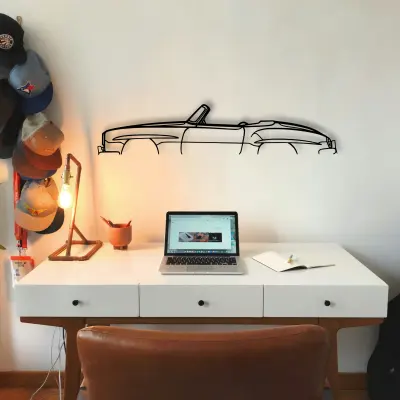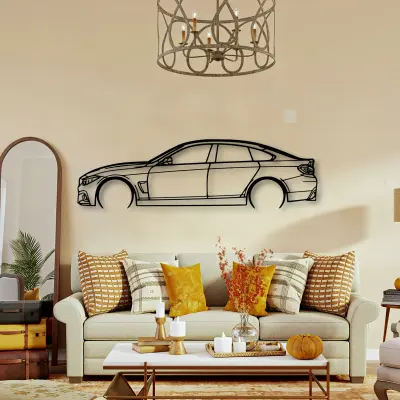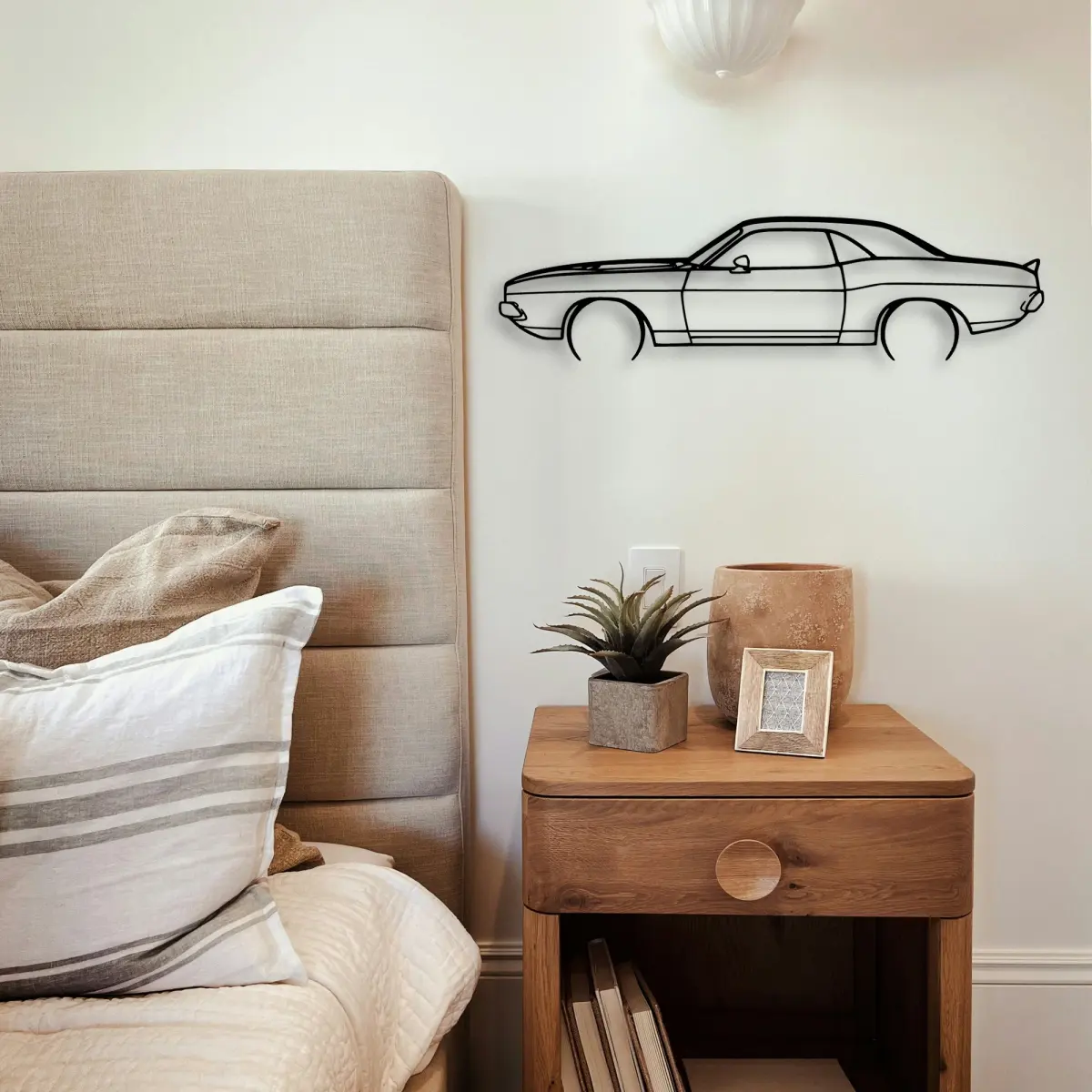
Most photos of metal art fail for one reason: they fight the piece. A Dodge profile wants clean light and a calm background, not a clever setup.
The Dodge Challenger 1970 dates to 1970, and that year's proportions are exactly what the cut outline keeps — the roofline and the stance are period-correct, not stylised.
The Dodge pieces in our range are cut from sheet metal and delivered ready to mount, with the price stepping from $69.95 at 50 cm to $209.95 at 140 cm — a range that lets the same outline work over a desk or across a full wall.
Honest material, no colour
A Dodge profile in steel asks the line to do all the work — there is no livery, no badge colour, no gradient to lean on.
More than one on the backing
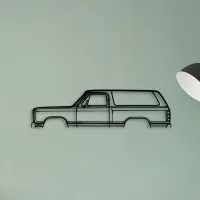
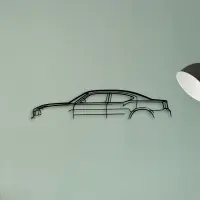
A row of Dodge outlines, each a different car, turns a wall into a timeline you can read at a glance.
Build the set
Reading it from across the room
A Dodge profile has to work at distance, not just up close. At 120 cm it keeps its identifying line legible from the other end of the room.
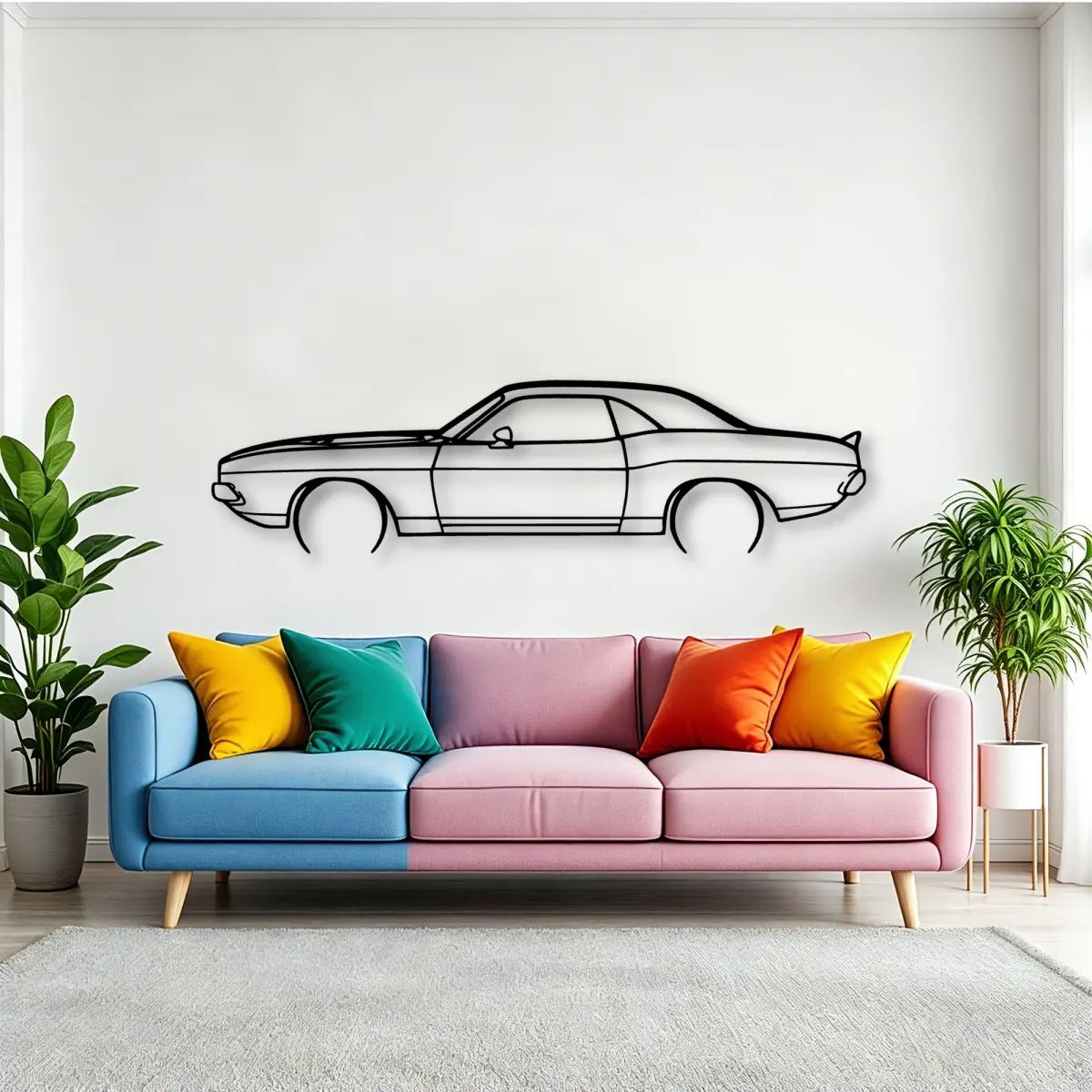
Why it suits a den wall
Garages reward honest shapes. The Dodge cut from steel belongs there in a way a framed poster never quite does.
Fixings and the backing
Every Dodge piece ships with the fixings needed to mount it. On a solid wall, a single anchor per tab is enough for the weight of cut steel.
Size ladder, one outline
Size ladder, one outline. The Dodge is offered from a 50 cm shelf piece up to a 140 cm statement, all cut to the same profile.
- 50 cm — a shelf or a study; an accent, not a feature.
- 80 cm — still modest, but reads across a doorway.
- 100 cm — the safe feature-wall default.
- 120 cm — for rooms where the car is the subject.
- 140 cm — the full statement piece.
The room sets the size. A busy wall wants a bigger outline to hold its own; a calm wall lets a smaller piece breathe.
Start with one. A single correct piece teaches the eye what the rest of the backing should do.
A profile on the backing is a quiet kind of confidence. It does not shout the spec sheet; it simply states the shape.
Hang it where the light lands first. The edge you notice on the way in is the edge worth cutting.
A piece does not need a frame to feel finished. The cut edge is the frame.
The shadow line is the second drawing. Where it falls tells you as much as the metal itself.
A dedicated wall beats a crowded one. Give the car room and it repays the attention.
The best wall pieces are the ones you stop seeing as decor and start reading as a subject.
Metal art works best when it earns its place rather than filling a gap. A single well-chosen outline does more than a row of hesitant decoration.
Colour is optional here. The outline carries the identity, so the backing behind it can stay exactly as it is.
A profile ages better than a photograph. There is no moment to date it and no colour to fall out of fashion.