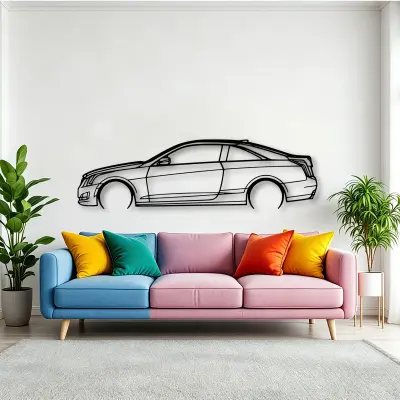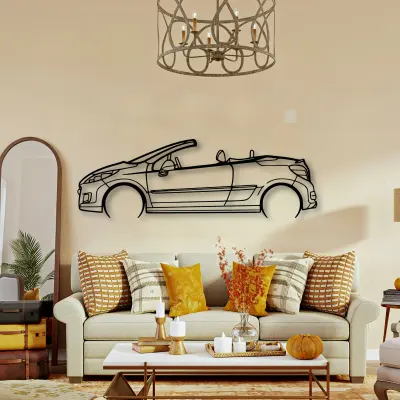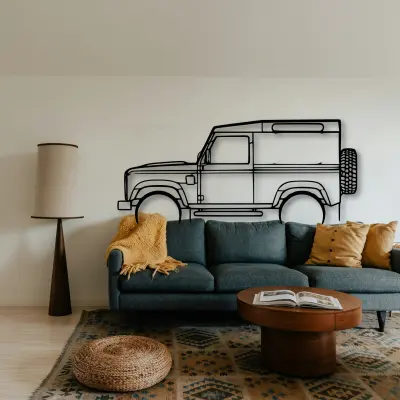
Put a convertible and a coupé side by side and the difference is obvious to anyone. Put them side by side as flat metal cut-outs on a wall and the difference becomes a design question rather than a mechanical one: which shape holds a wall better?
The short answer is that the coupé usually wins on contrast and the convertible usually wins on character. The longer answer depends on the size you buy, the wall you hang it on, and how far away you stand.
Profile comparison: Convertible against Coupé
Both are two-door body styles. The mechanical difference is the roof. The visual difference is everything that follows from it:
- A coupé has a fixed roof, so its greenhouse is a closed shape. The silhouette reads as a solid, continuous mass with a strong horizontal line at the beltline.
- A convertible has no roof, or a folding one. With the top down, the side profile is defined by the windshield frame and a low or absent rear deck line. The silhouette reads as open and airy.
- With the top up, a convertible silhouette can be very close to a coupé's. What separates them is usually the rear — convertibles often carry a shorter deck and a more abrupt finish.
Roofline and stance differences
The coupé's advantage is negative space. A closed roof gives you a large, clean shape that reads from a distance, and the beltline cuts it into two clear zones. That is why a coupé silhouette tends to stay legible at smaller sizes.
The convertible's advantage is silhouette recognisability. An open-top profile is unusual — most cars on the road are closed — so it registers as distinct even when the detail is soft. It also casts a different shadow, because the windshield frame creates gaps in the cut-out that let light through.
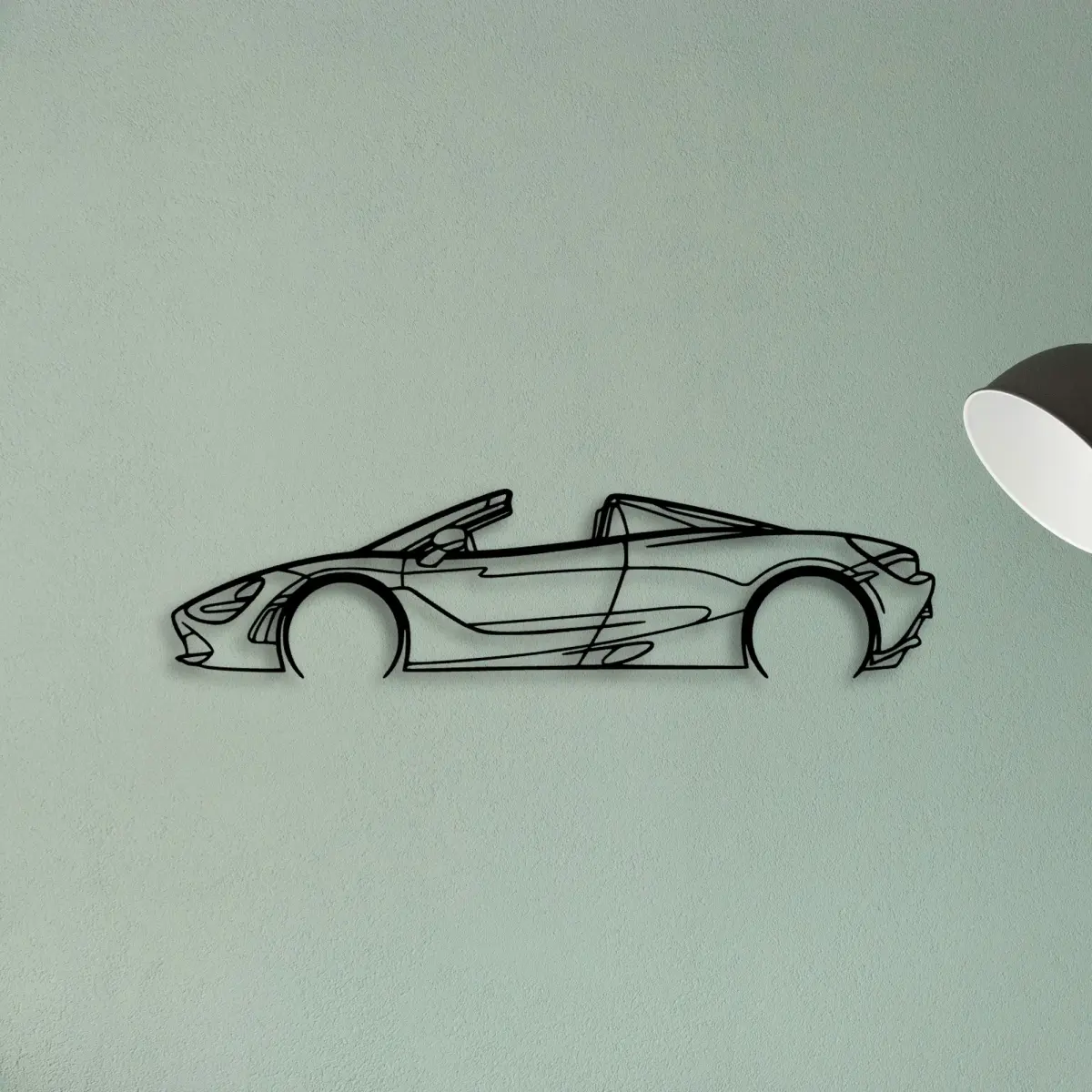
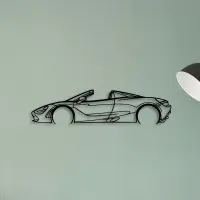
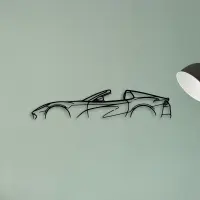
Look at the two pieces below. The 720S Spyder 2018 is a convertible: the profile is defined by a low windshield and a fast rear deck, and the cut-out has real gaps around the cockpit. The 812 GTS Spider is also a convertible but a much longer one, so the open area is stretched and the shape reads as leaner rather than airier.
Two open-top silhouettes, two characters
Room-size recommendations
Because a coupé's outline is denser, it tolerates smaller walls better. A 50 cm coupé piece on a narrow hallway wall still reads as a car. A 50 cm convertible piece on the same wall can look like a fragment, because the open areas read as missing detail rather than as design.
- Up to 80 cm: choose a coupé, or a convertible with a long body that carries its own visual weight.
- 100 cm to 120 cm: both work well. This is the range where the convertible's open areas start reading as deliberate gaps.
- 140 cm: the convertible is the stronger choice. At that size the open cockpit becomes a feature, and the shadow it casts becomes part of the piece.
Which to choose for your space
Ask one question: how far will people stand from it? If the answer is 'across a room', take the coupé — its density survives distance. If the answer is 'passing close by', take the convertible — its unusual open shape rewards a closer look and the shadow does the rest.
If you are buying for a garage or workshop, the convertible is usually the better bet. Those spaces are viewed up close, often from a standing position, and the extra gaps in the cut-out read as detail rather than absence.