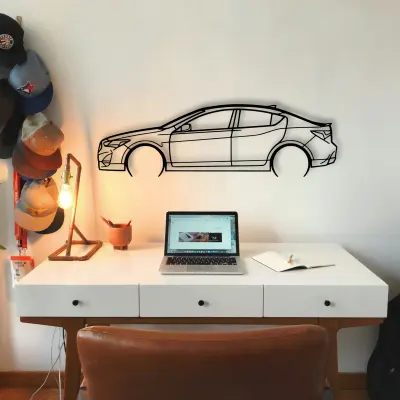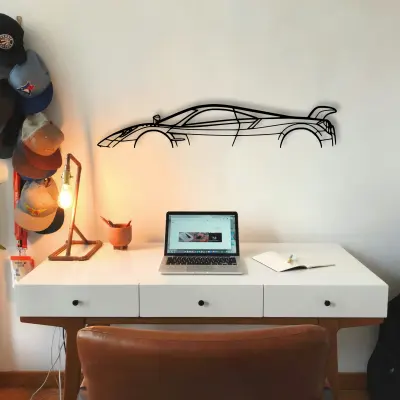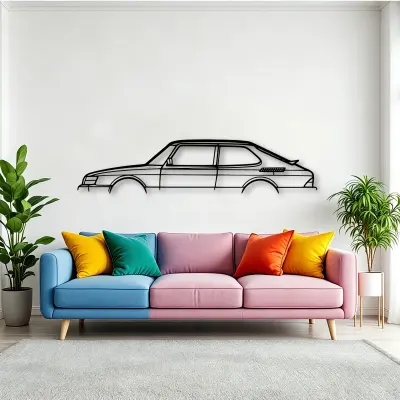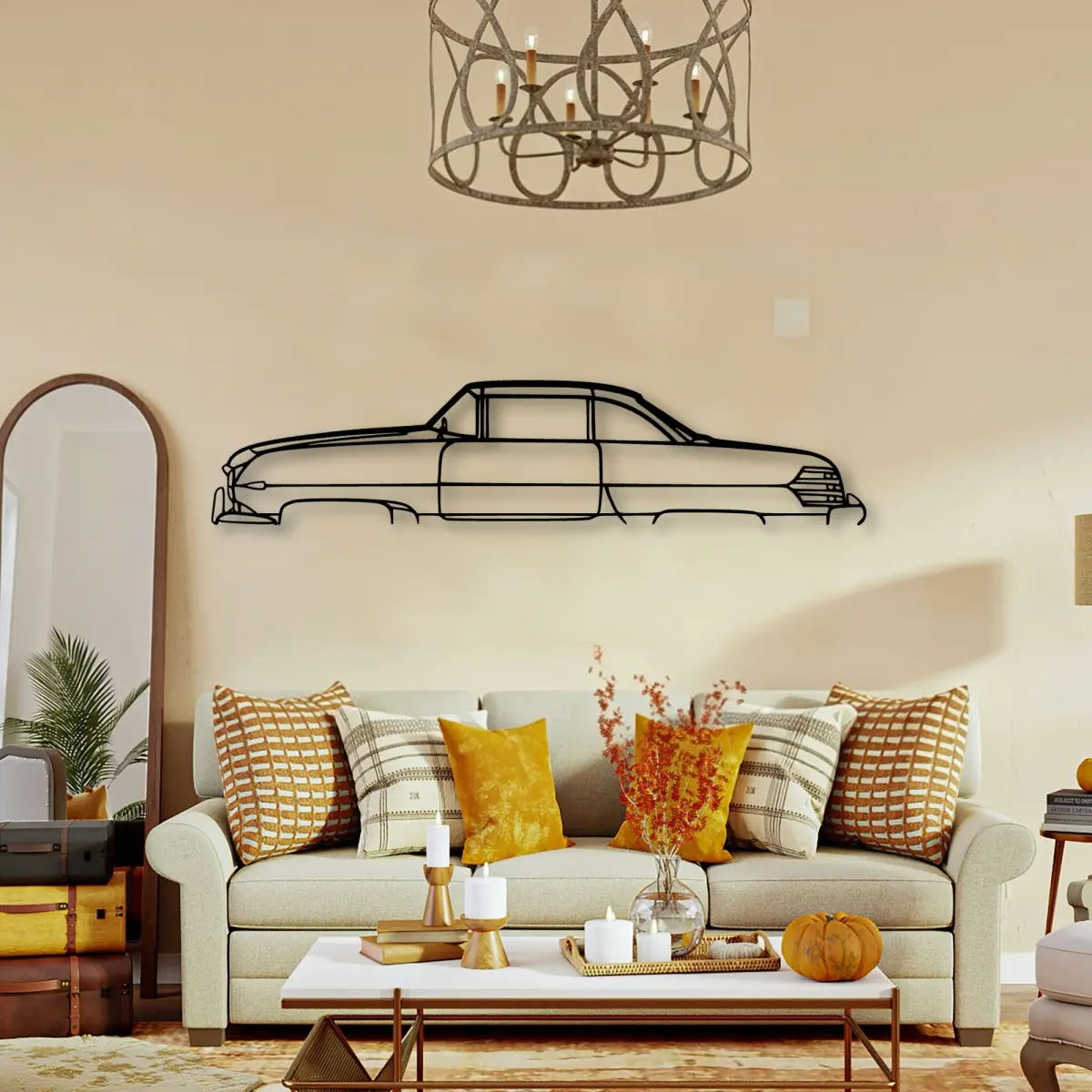
Most road trips are remembered in photos that never get printed. A Hudson sheet-metal profile turns the best of them into something you actually hang.
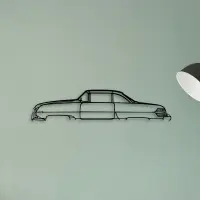
The Hudson Hudson Italia 1954 dates to 1954, and that year's proportions are exactly what the cut outline keeps — the roofline and the stance are period-correct, not stylised.
At Tinvibe the Hudson is offered as a sheet-metal profile in size ladder, from 50 cm to 140 cm, finished for indoor wall display. The smaller sizes suit a shelf or a study; the larger sizes take a full den.
Size ladder for the memory
Size ladder, one outline. The Hudson is offered from a 50 cm shelf piece up to a 140 cm statement, all cut to the same profile.
- 50 cm — a shelf or a study; an accent, not a feature.
- 80 cm — still modest, but reads across a doorway.
- 100 cm — the safe feature-wall default.
- 120 cm — for rooms where the car is the subject.
- 140 cm — the full statement piece.
Why it suits a den wall
A Hudson in cut metal belongs in the spaces cars actually live in. Over a workbench or a parked car it reads instantly.
More than one on the backing
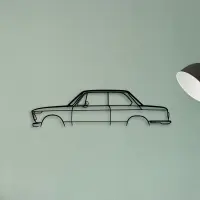
If you collect drives, let the Hudson be one of a set with a rule. Next to its rivals, the differences are obvious.
Build the set
Honest material, no colour
A Hudson profile in steel asks the line to do all the work — there is no livery, no badge colour, no gradient to lean on.
The solo drive
A Hudson enthusiast often drives alone on purpose. The quiet is the point, and the profile at home is the proof it happened.
Maintenance is close to nothing. A quick dust is enough; there are no frames to chip and no glass to clean.
A single strong subject is easier to live with than a wall that argues with itself.
The backing behind should be the quietest thing in the room. Let the outline be the loud part.
Give it room to mean something. A profile left alone on a clear wall says more than the same shape lost in a crowd.
Colour is optional here. The outline carries the identity, so the backing behind it can stay exactly as it is.
A dedicated wall beats a crowded one. Give the car room and it repays the attention.
Think in edges, not pictures. The cut defines the object, and the shape defines the cut.
The shadow line is the second drawing. Where it falls tells you as much as the metal itself.
The room sets the size. A busy wall wants a bigger outline to hold its own; a calm wall lets a smaller piece breathe.
Light from the side reveals the cut; light from the front flattens it. Aim for the reveal.
Resist the urge to fill. An empty margin around the outline is what makes it feel considered.
A profile ages better than a photograph. There is no moment to date it and no colour to fall out of fashion.
The profile is the cheapest way to own the shape without owning the car.
Pick the outline that matches the room's energy: calm spaces want restraint, busy ones want a statement.