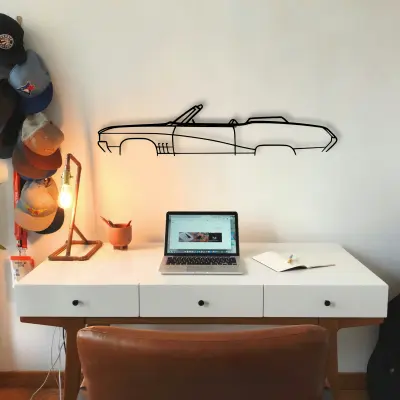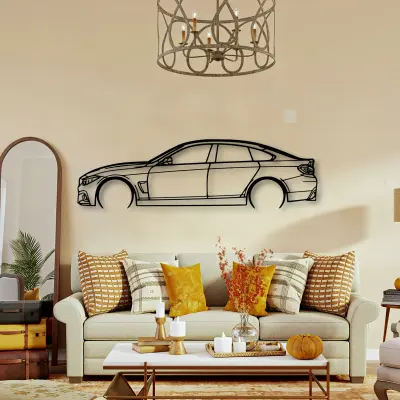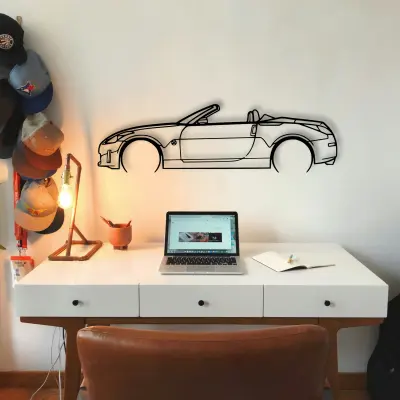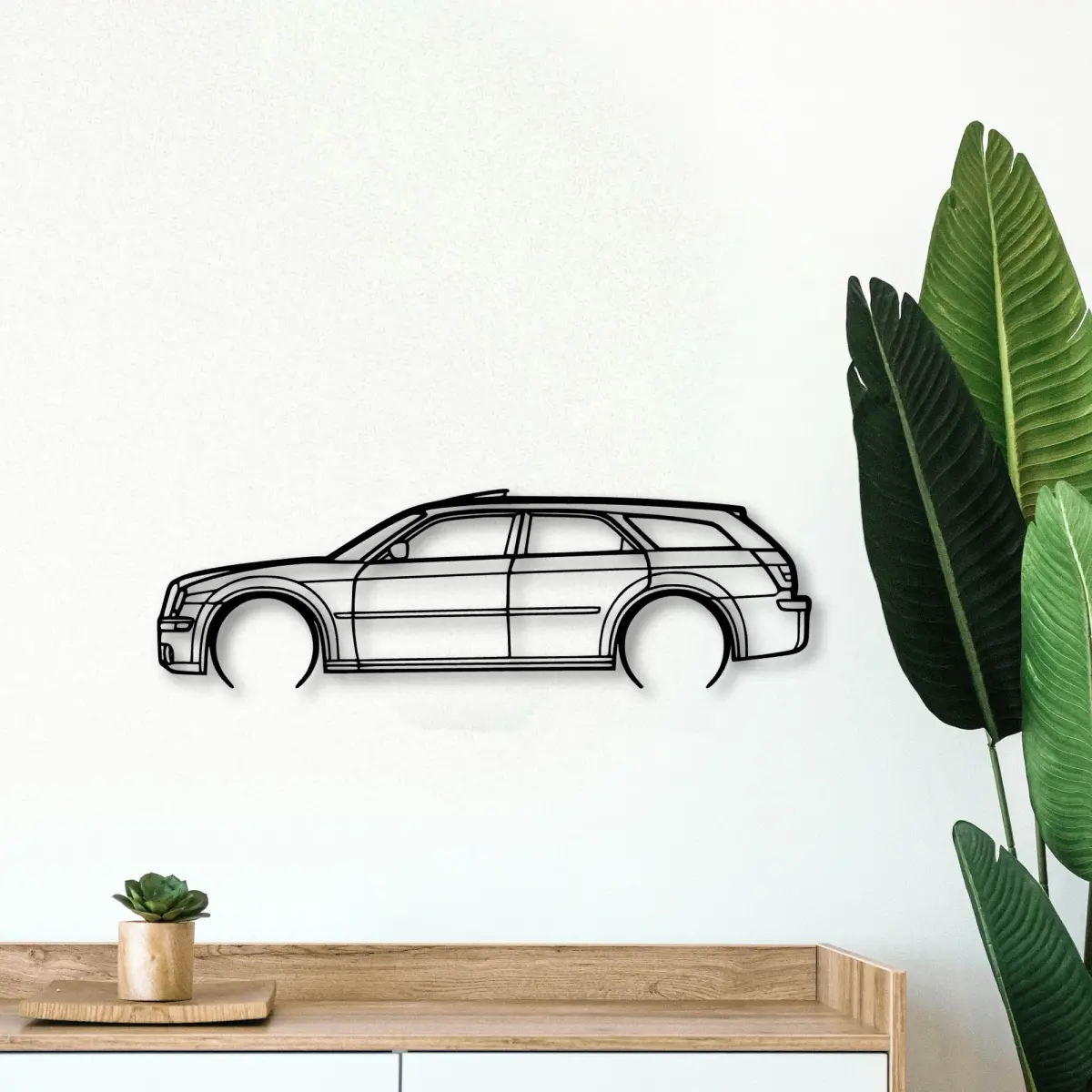
Driving culture is mostly small rituals: the prep, the playlist, the stop for coffee. A Chrysler outline is the part you keep.
The Chrysler 300c 2006 Touring dates to 2006, and that year's proportions are exactly what the cut outline keeps — the roofline and the stance are period-correct, not stylised.
At Tinvibe the Chrysler is offered as a sheet-metal profile in size ladder, from 50 cm to 140 cm, finished for indoor wall display. The smaller sizes suit a shelf or a study; the larger sizes take a full living room.
One piece, one trip
A single Chrysler profile per journey reads as a chapter. A wall of them becomes an autobiography.
More than one on the backing
A row of Chrysler outlines, each a different trip, turns a wall into a timeline you can read at a glance.
Build the set
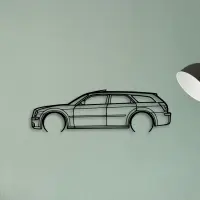
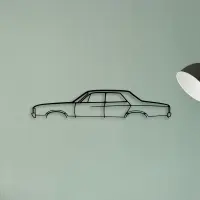
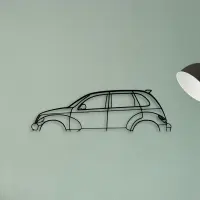
Era written into the line
You can often date a Chrysler by its roof alone. The cut keeps those period cues so the shape reads as a moment without a caption.
Honest material, no colour
A Chrysler profile in steel asks the line to do all the work — there is no livery, no badge colour, no gradient to lean on.
Size ladder for the memory
Every Chrysler profile comes in the same size ladder: 50 cm, 80 cm, 100 cm, 120 cm and 140 cm. The price steps with the size, from $69.95 to $209.95.
- 50 cm — a shelf or a study; an accent, not a feature.
- 80 cm — still modest, but reads across a doorway.
- 100 cm — the safe feature-wall default.
- 120 cm — for rooms where the car is the subject.
- 140 cm — the full statement piece.
Placement is a quiet decision. Sightline for a statement wall, slightly by a workstation, and well clear of a door swing that would clip it.
A row of identical small frames fights itself. One larger outline settles the backing instead.
Light from the side reveals the cut; light from the front flattens it. Aim for the reveal.
A profile ages better than a photograph. There is no moment to date it and no colour to fall out of fashion.
Lighting decides the mood. An even wash from above flatters the edge; a single hard spotlight only hardens one corner.
The profile is the cheapest way to own the shape without owning the car.
A neutral wall is a gift. It lets the cut do the talking without competing colour.
A profile on the backing is a quiet kind of confidence. It does not shout the spec sheet; it simply states the shape.
Give it room to mean something. A profile left alone on a clear wall says more than the same shape lost in a crowd.
The room sets the size. A busy wall wants a bigger outline to hold its own; a calm wall lets a smaller piece breathe.
A dedicated wall beats a crowded one. Give the car room and it repays the attention.
Metal art works best when it earns its place rather than filling a gap. A single well-chosen outline does more than a row of hesitant decoration.