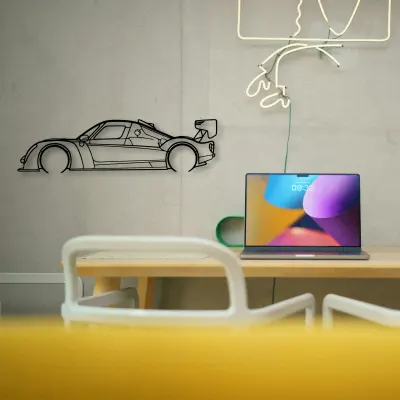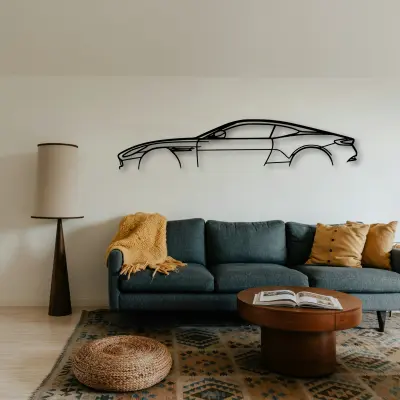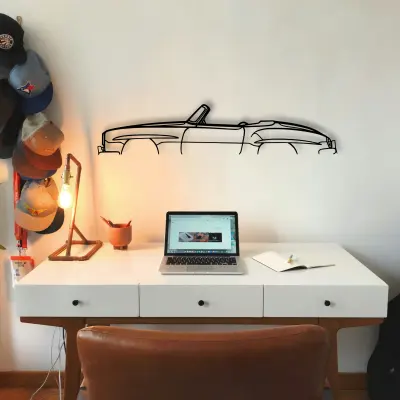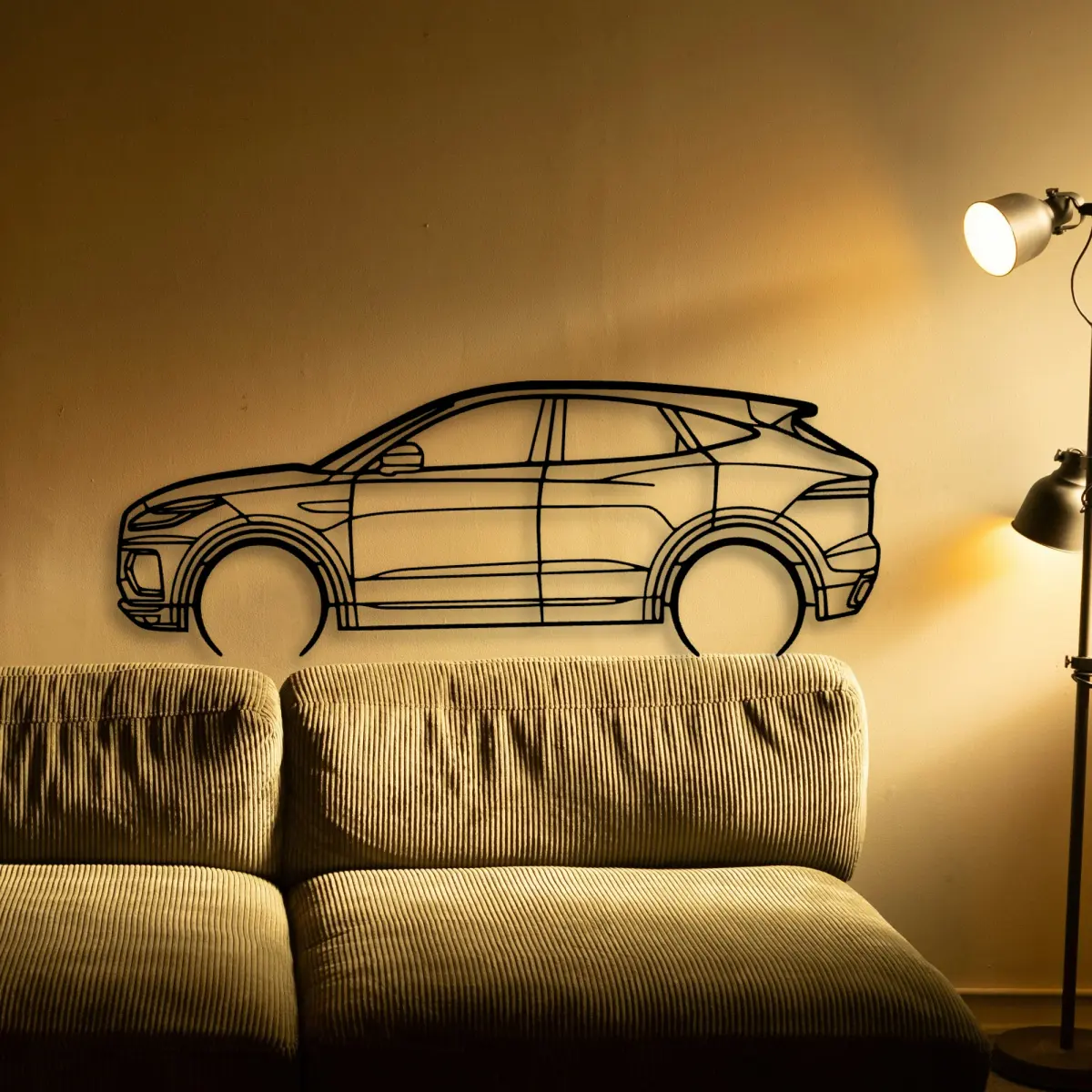
Most photos of wall art fail for one reason: they fight the piece. A Jaguar silhouette wants clean light and a calm background, not a clever setup.
The Jaguar E Pace R Dynamic 2022 dates to 2022, and that year's proportions are exactly what the cut outline keeps — the roofline and the stance are period-correct, not stylised.
The Jaguar pieces in our range are cut from sheet metal and delivered ready to mount, with the price stepping from $69.95 at 50 cm to $209.95 at 140 cm — a range that lets the same outline work by a workstation or across a full wall.
Five sizes, one outline
Every Jaguar silhouette comes in the same five sizes: 50 cm, 80 cm, 100 cm, 120 cm and 140 cm. The price steps with the size, from $69.95 to $209.95.
- 50 cm — a shelf or a study; an accent, not a feature.
- 80 cm — still modest, but reads across a doorway.
- 100 cm — the safe feature-wall default.
- 120 cm — for rooms where the car is the subject.
- 140 cm — the full statement piece.
Context over close-up
A Jaguar silhouette reads best in a real room, not as a zoomed crop. Show the wall, not just the metal.
Honest material, no colour
Because the Jaguar comes in bare cut metal, every proportion is exposed. That is harder than a photograph, and it is why a good outline feels earned.
Shoot before you hang
The easiest Jaguar silhouette photo is the one taken before it goes on the wall, flat and lit evenly. Hang later; post now.
More than one on the wall
A row of Jaguar outlines, each a different car, turns a wall into a timeline you can read at a glance.
Build the set
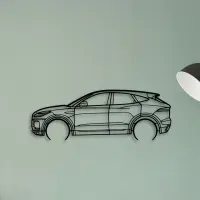
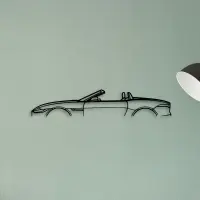
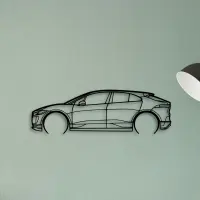
A neutral wall is a gift. It lets the cut do the talking without competing colour.
Grouping works when the shapes contrast. A long low outline next to a tall upright one reads as a conversation, not a pile.
A row of identical small frames fights itself. One larger outline settles the wall instead.
Depth comes from the shadow. The gap between metal and wall is part of the composition, not a flaw.
Think in edges, not pictures. The cut defines the object, and the shape defines the cut.
Hang two that differ in length, not in mood, and they read as a pair rather than a repeat.
Hang it where the light lands first. The edge you notice on the way in is the edge worth cutting.
A silhouette travels. Move it between rooms and it still makes sense, because the shape is the message.
Recognition is the whole point. The outline is built so the car reads before the words do.
Lighting decides the mood. An even wash from above flatters the edge; a single hard spotlight only hardens one corner.
Colour is optional here. The outline carries the identity, so the wall behind it can stay exactly as it is.
The shadow line is the second drawing. Where it falls tells you as much as the metal itself.
Quiet rooms suit a smaller silhouette; loud rooms need one that can hold its own from across the space.