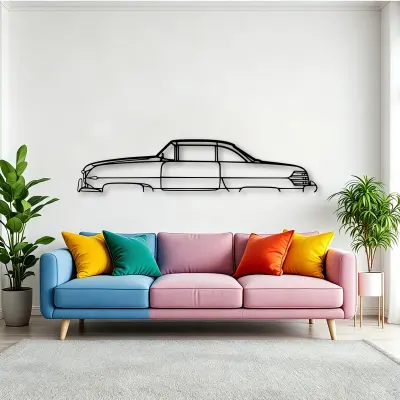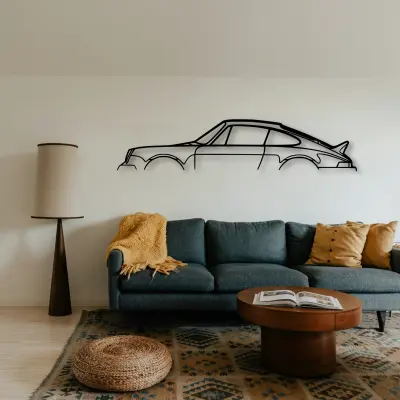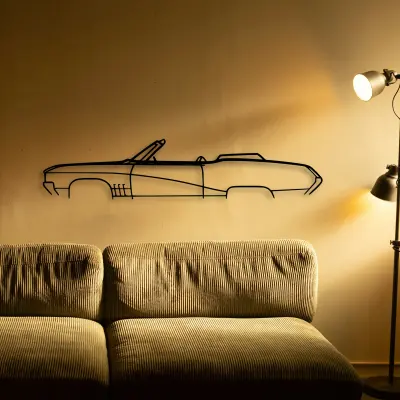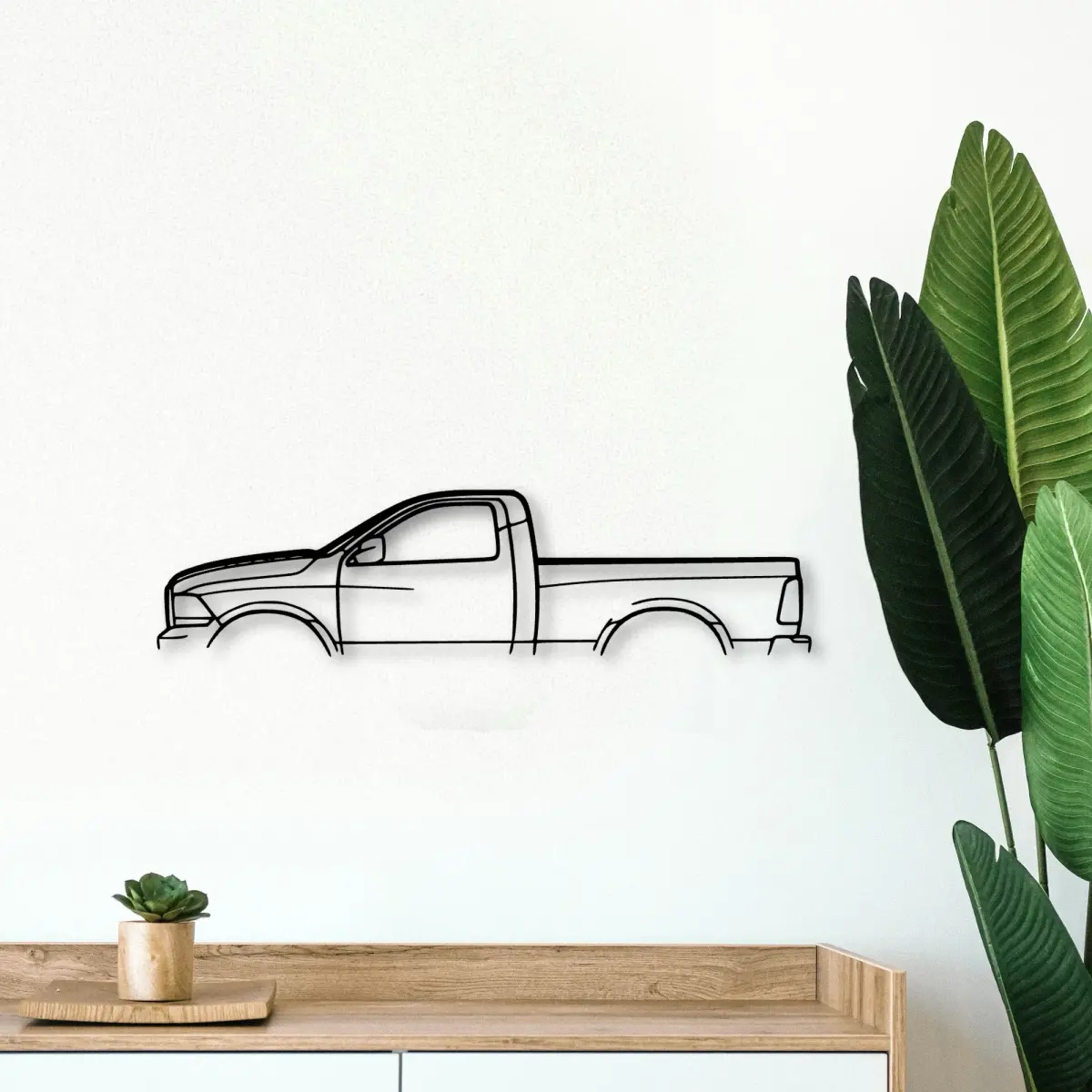
The RAM outline reads as a shape first and a car second. Photographing it is really about capturing that shape, not the metal.
The Ram Ram 1500 2013 dates to 2013, and that year's proportions are exactly what the cut outline keeps — the roofline and the stance are period-correct, not stylised.
The RAM pieces in our range are cut from sheet metal and delivered ready to mount, with the price stepping from $69.95 at 50 cm to $209.95 at 140 cm — a range that lets the same outline work by a workstation or across a full wall.
Context over close-up
For a RAM piece, a photo that includes the space tells more than a macro of the cut.
Era written into the line
Period is baked into proportion. A RAM from one decade sits differently from another, and a shape is the fastest way to see that gap.
Honest material, no colour
Because the RAM comes in bare cut metal, every proportion is exposed. That is harder than a photograph, and it is why a good outline feels earned.
Why it suits a shed wall
A RAM in cut metal belongs in the spaces cars actually live in. Over a workbench or a parked car it reads instantly.
More than one on the panel
A row of RAM outlines, each a different car, turns a wall into a timeline you can read at a glance.
Build the set
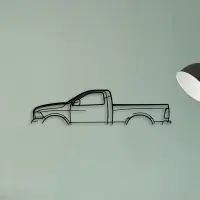
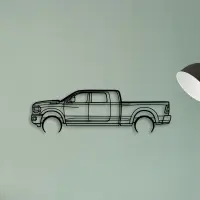
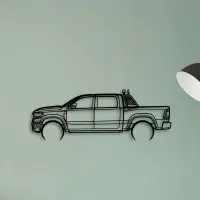
Five options, one outline
Every RAM shape comes in the same five options: 50 cm, 80 cm, 100 cm, 120 cm and 140 cm. The price steps with the size, from $69.95 to $209.95.
- 50 cm — a shelf or a study; an accent, not a feature.
- 80 cm — still modest, but reads across a doorway.
- 100 cm — the safe feature-wall default.
- 120 cm — for rooms where the car is the subject.
- 140 cm — the full statement piece.
The shadow line is the second drawing. Where it falls tells you as much as the metal itself.
A shape ages better than a photograph. There is no moment to date it and no colour to fall out of fashion.
Give it room to mean something. A shape left alone on a clear wall says more than the same shape lost in a crowd.
Grouping works when the shapes contrast. A long low outline next to a tall upright one reads as a conversation, not a pile.
Metal keeps its line. Unlike paper, it will not curl, fade, or bow under a warm lamp.
The panel behind should be the quietest thing in the room. Let the outline be the loud part.
A profile on the panel is a quiet kind of confidence. It does not shout the spec sheet; it simply states the shape.
Maintenance is close to nothing. A quick dust is enough; there are no frames to chip and no glass to clean.
Light from the side reveals the cut; light from the front flattens it. Aim for the reveal.
Think in edges, not pictures. The cut defines the object, and the shape defines the cut.
Start with one. A single correct piece teaches the eye what the rest of the panel should do.
A shape travels. Move it between rooms and it still makes sense, because the shape is the message.