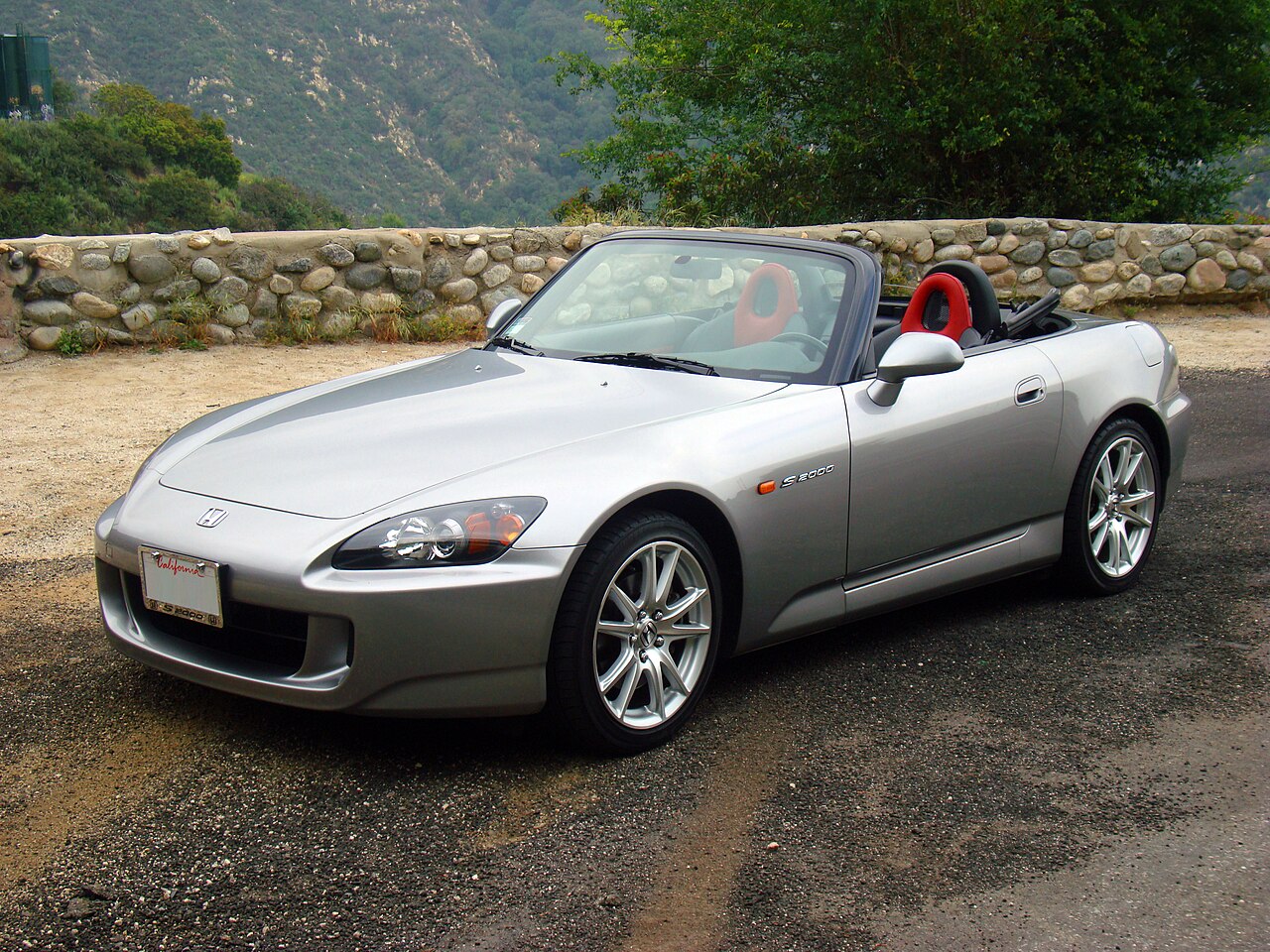
The Honda S2000 launched in 1999 as a homage to the roadsters of the 1960s — a front-engine, rear-wheel-drive two-seater built to mark Honda's own 50th anniversary. Its defining feature was the F20C, a 2.0-litre four-cylinder that revved to 9,000 rpm and made more power per litre than almost anything else, all wrapped in one of the best-balanced chassis of its era.
Generations and evolution
AP1 (1999–2004)
The original S2000 with the 9,000-rpm F20C engine — a pure, high-revving roadster.
AP2 (2004–2009)
A revised version with the larger F22C engine, revised suspension and a slightly softer setup for everyday use.
Design language and the silhouette
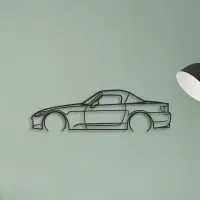
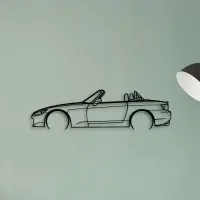
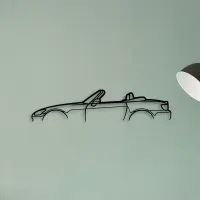
Classic roadster proportions: a long hood, a low windscreen and a compact cabin right over the rear axle, with pop-up headlamps on the AP1 giving it a period-correct charm. Because we cut every Tinvibe piece from 2 mm steel to the car's true outline, the traits that make the Honda S2000 recognizable — its roofline, stance and key details — are exactly what the metal keeps, in matte black powder coat across five sizes from 50 cm to 140 cm.
Production, sales and availability
Honda has not published a single lifetime S2000 total across its generations, so we avoid quoting one; production ended in 2009, and the high-revving AP1 is the most sought-after.
The S2000 in the Tinvibe collection
We cut the Honda S2000 as a laser-cut steel silhouette in five sizes from 50 cm to 140 cm, finished in matte black powder coat. The designs below are drawn from our catalogue for this nameplate.